

Unlocking Wealth: Advanced Tax Planning for Entrepreneurs and Beyond
Unlock wealth with advanced tax strategies! Learn income shifting, real estate depreciation, and retirement planning to cut taxes.

Advanced tax strategies are legally structured methods that help high-income earners, business owners, and investors reduce their tax burden across income, capital gains, and estate taxes through proactive planning rather than year-end scrambling. For entrepreneurs making $400,000 or more annually, the difference between generic tax advice and strategic tax planning can mean tens of thousands of dollars in annual savings.
Key Advanced Tax Strategies for High Earners:
Most high-income earners are bleeding tens of thousands in tax each year, not because they lack intelligence, but because their CPAs or advisors default to safe, generic methods instead of deploying advanced strategies. The challenge is not finding strategies. The challenge is knowing which ones apply to your situation, when to implement them, and how to coordinate them for maximum impact.
The research is clear: the most sophisticated tax planning combines multiple strategies. For example, pairing S Corp election with Section 199A qualified business income deduction, cost segregation on real estate, and a cash balance retirement plan can generate $100,000 or more in annual tax savings for the right business owner.
But complexity brings risk. Aggressive reclassification without proper documentation, missed compliance requirements, and poorly timed conversions can trigger audits or eliminate tax benefits entirely. The most common mistake high-net-worth individuals make is being reactive rather than proactive, waiting until year-end to minimize the current year's income tax instead of implementing multi-year structural planning.
I'm Daniel Delaney, founder of Seek & Find Financial, and throughout my career in financial services I've seen how advanced tax strategies transform long-term wealth when implemented correctly as part of a comprehensive financial plan. This guide will walk you through the most effective strategies for high earners, explain how they work in real situations, and show you when professional guidance becomes essential.
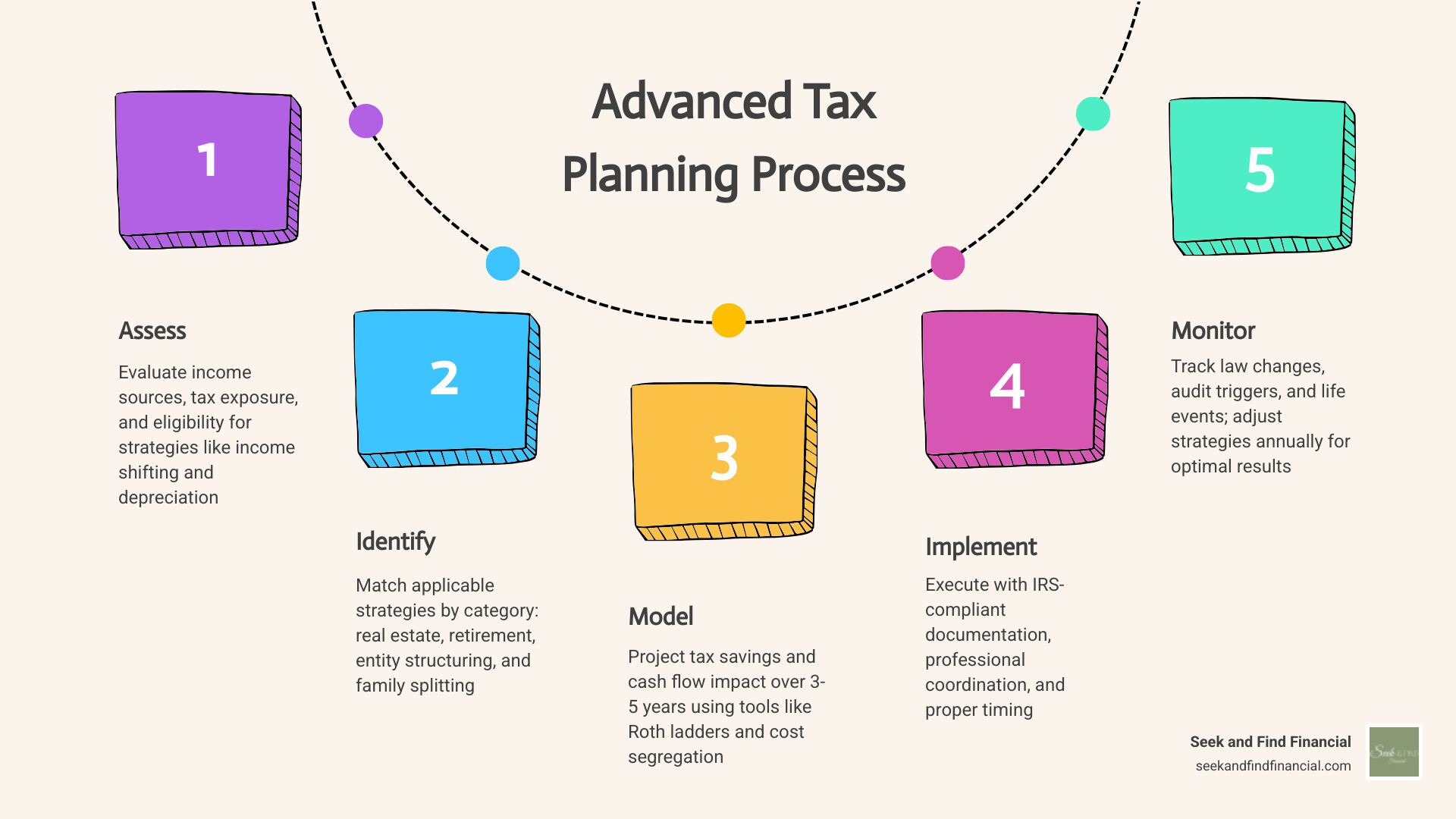
Income shifting is a powerful way to keep more of what you earn. The goal is simple. We move income from a person in a high tax bracket to a person or entity in a lower tax bracket. For high-net-worth individuals, this often involves family members.
One common way to do this is through income splitting. If you own a business, you might hire your children to perform real work. You pay them a fair wage. The business gets a deduction. The child earns income that is often taxed at a very low rate or not at all if it falls under the standard deduction. This helps fund their future while lowering your current tax bill.
Another tool is the use of spousal retirement accounts or family trusts. By directing assets into a trust, the income generated by those assets can sometimes be taxed at the beneficiaries' lower rates. This is not just about saving money today. It is a way to support your legacy goals. You are moving wealth to the next generation while the IRS takes a smaller bite.
For business owners in places like Valparaiso or Crown Point, choosing the right structure is key. An S Corporation can be a great tool for income shifting. By paying yourself a "reasonable salary" and taking the rest as distributions, you can save significantly on self-employment taxes. We have seen cases where an S Corp alone slices $18,000 to $37,000 off a tax bill for high-earning professionals.

Real estate is one of the best ways to build wealth because the tax code loves property owners. Most people think you have to wait 27.5 or 39 years to write off a building. With advanced tax strategies, we can speed that up.
This is called accelerated depreciation. We use a "cost segregation study" to find parts of the building that can be written off much faster. Instead of 39 years, we look for items that qualify for 5, 7, or 15-year lives. When you combine this with bonus depreciation, you can create a massive deduction in the very first year.
Certain niches are perfect for this. Gas stations are often called the "gold standard" for this strategy. If a facility meets certain rules, like being under 1,400 square feet or getting half its revenue from fuel, the whole building might qualify for 15-year depreciation.
| Asset Type | Typical Year 1 Acceleration | Key Tax Rule |
|---|---|---|
| Gas Stations | 90% - 100% | IRS Revenue Ruling 97-29 |
| Car Washes | 80% - 100% | Rev. Proc. 87-56 (Asset Class 57.1) |
| Mobile Home Parks | 50% - 75% | 15-year Land Improvements |
| Self-Storage | 25% - 45% | Movable Partitions & Site Work |
Mobile home parks are also great. While the homes themselves might be 27.5-year property, the roads, pads, and utility hookups are often 15-year land improvements. If you own the mobile homes and they aren't permanently attached to the ground, we might even classify them as 5 or 7-year personal property.
To do this right, you need to follow IRS Publication 946. This guide explains how to depreciate property correctly. Using these niches allows you to offset your high income with "paper losses" while your cash flow stays strong.
If you are an executive or a founder, your wealth might be tied up in stock. Managing this requires a plan that looks at more than just the stock price. We focus on tax diversification. This means having money in three types of buckets: taxable, tax-deferred (like a 401k), and tax-free (like a Roth).
Having money in different buckets gives you flexibility in retirement. You can choose where to pull money from to stay in a lower tax bracket.
For high earners, standard retirement limits are often too low. We look at advanced tools to move more money into tax-favored accounts:
These plans are like a high-performance engine. They work great, but they need expert tuning. If you try to do it yourself, you might hit a "red flag." The IRS looks closely at things like "reasonable compensation" for S Corps or aggressive cost segregation.
Laws change fast. A strategy that worked last year might be risky this year. In places like Chicago or Northwest Indiana, state tax rules also play a big role. We provide personalized, technology-driven planning to ensure your strategy fits your real life. We don't just give generic advice. We model your cash flow and look at the long-term impact of every move.
Income shifting is moving money from a high-tax environment to a low-tax one. This is usually done by moving income to family members in lower brackets or using business entities. It is a legal way to improve tax efficiency. It helps your wealth grow faster because you are losing less to the government.
It creates big tax deductions early on. By using cost segregation, you can take a large chunk of your building's cost as a deduction in Year 1. This improves your cash flow. You can use that extra cash to buy more property or invest in your business. It turns your real estate into a tax-saving machine.
The biggest risk is an IRS audit if things aren't documented well. There are also high costs to set some of these up, like engineering reports for cost segregation. If you get the wrong advice, you could end up paying penalties. That is why having a clear, structured plan and professional help is vital.
At Seek & Find Financial, we believe tax planning should be a system, not a one-time task. Whether you are in Chesterton, Hobart, or Merrillville, you deserve a strategy that looks at your whole financial life. We focus on clarity and long-term growth.
Advanced tax planning is about more than just saving money this April. It is about building a foundation for your family and your business. By using the right tools at the right time, you can turn tax complexity into a growth opportunity.
If you are ready for a clear direction and a personalized strategy, we are here to help. You can learn more about our wealth management services to see how we can help you protect what you've built.
Investing involves risk, including possible loss of principal. No investment strategy can ensure financial success or guarantee against losses. Past performance may not be used to predict future results. Provided content is for overview and informational purposes only, reflect the opinions of the author, and is not intended and should not be relied upon as individualized tax, legal, fiduciary, or investment advice.
This information is being provided only as a general source of information. These views may change as market or other conditions change. This information is not intended and should not be used to provide financial advice and does not address or account for an individual’s circumstances. Past performance does not guarantee future results and no forecast should be considered a guarantee. Please seek the guidance of a financial professional regarding your particular financial concerns.
Investment advisory services offered by duly registered individuals through Seek & find Financial LLC a Registered Investment Adviser. Licensed Insurance Professional