

Capital Control: The Secrets to Effective Business Financial Management
Master Business capital management: Boost cash flow, optimize ratios, and drive growth with proven strategies and expert tips.

Business capital management is the process of managing your company's short-term assets and liabilities to maintain liquidity, fund operations, and drive long-term growth. Here's what you need to know:
Quick Answer: What is Business Capital Management?
Many business owners struggle with the same challenge. Revenue is strong, but cash flow feels tight. Bills pile up while customers take 60 days to pay. You want to invest in new equipment or hire more staff, but you're not sure if the capital is really there.
This tension between profitability and liquidity sits at the heart of business capital management. According to a recent Deloitte poll, nearly half of executives say managing working capital is a high priority, with 33.6% keeping it at the top of their list and 14.7% making it an even higher priority than before.
The reason is simple. Effective capital management determines whether your business thrives, survives, or fails. Companies that master this discipline can fund operations smoothly, seize growth opportunities, and build real enterprise value. Those that don't often face cash crunches, missed opportunities, and strained vendor relationships, even when profits look good on paper.
I'm Daniel Delaney, founder of Seek & Find Financial, and I've helped business owners and entrepreneurs structure their finances for long-term stability and growth throughout my career. Business capital management is often the difference between a company that scales efficiently and one that struggles despite strong sales.
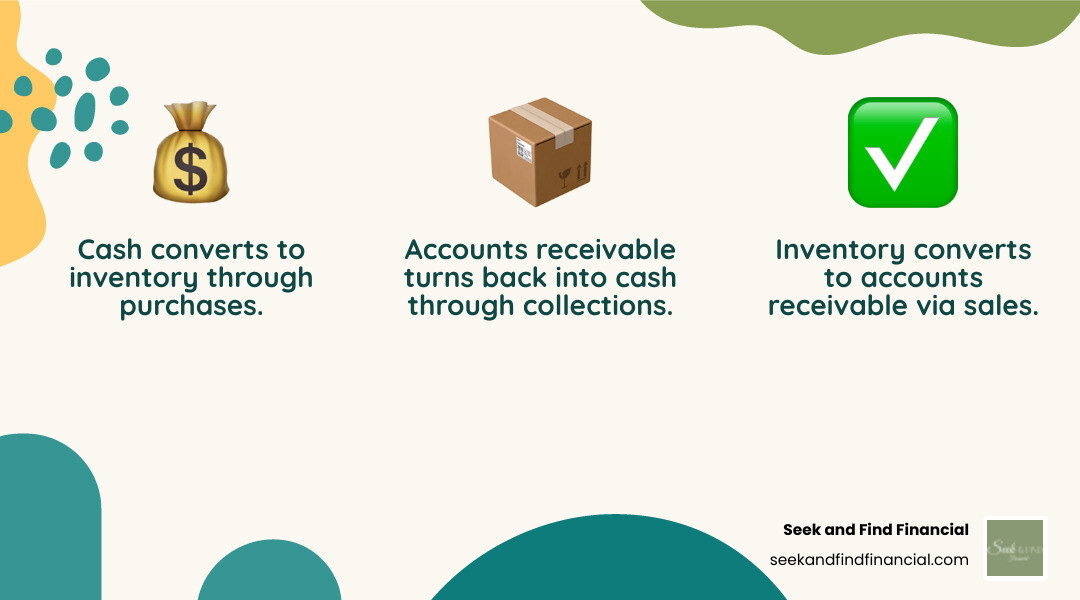
At Seek & Find Financial, we believe that clarity is the foundation of wealth. For a business owner in Valparaiso or Crown Point, business capital management is not just about counting beans. It is about making sure your business has the "fuel" it needs to keep moving. This fuel is called liquidity.
Liquidity is how easily you can turn assets into cash to pay your bills. If you have a million dollars in inventory but zero dollars in the bank, you are in trouble. You cannot pay your staff with boxes of product.
Strategic growth depends on how you use your money. A Deloitte poll shows that top leaders take this very seriously. They know that managing working capital keeps the company healthy. It helps you avoid risks like not being able to pay your rent or losing a good vendor because you paid late.
To manage your capital well, you need to look at four main parts:
When you manage these parts well, you create shareholder value. This means your business becomes worth more. Research shows that "outperformers" (the top companies) invest about 50% more in their business than their peers. They also see 55% higher returns on their assets.
Good business capital management is about discipline. It means you don't just spend money because you have it. You put it where it will grow. This makes your business more attractive to investors or buyers in the future.
How do you know if you are doing a good job? We use math to find out. There are specific ratios that tell the story of your financial health.
The first is the Current Ratio. You find this by dividing your current assets by your current liabilities. A ratio of 1.0 or higher means you can pay your short-term bills. A ratio of 2.0 is often considered very healthy.
The second is the Quick Ratio, also called the acid-test ratio. This is a tougher test. You take your current assets, subtract your inventory, and then divide by your liabilities. This shows if you can pay your bills right now without selling any more products. A ratio above 1.0 is usually a sign of good health.
You can learn more about these terms in this guide on working capital management explained.
| Metric | Formula | What it Measures | Healthy Range |
|---|---|---|---|
| Current Ratio | Current Assets / Current Liabilities | General ability to pay short-term debt | 1.0 to 2.0 |
| Quick Ratio | (Current Assets - Inventory) / Current Liabilities | Immediate ability to pay debt without selling stock | Above 1.0 |
Efficiency is about speed. How fast can you turn your work into cash?
If these numbers are moving in the right direction, your business is becoming a well-oiled machine.
Positive working capital means you have more assets than debts. This is usually good. it means you have room to grow.
Negative working capital means you owe more than you have in short-term assets. This can lead to a liquidity crunch. You might struggle to pay your team or your suppliers. However, some big stores like grocery chains have negative working capital because they sell products faster than they have to pay their vendors. For most small businesses in Indiana or Chicago, staying positive is the safer bet.
Every business owner has a different "risk appetite." How you manage your business capital management usually falls into one of three buckets.
In the research paper The Art of Capital Allocation, experts note that top companies balance these risks carefully. They invest in "businesses, not projects." This means they look at the big picture of their whole company.
If your cash flow feels weak, don't panic. There are ways to fix it. We often tell our clients at Seek & Find Financial to look at their systems first.
Automation is a huge help. Using technology to track your bills and invoices saves time and reduces errors. We use tools like Altruist to give our clients a clear view of their wealth. You should do the same for your business operations.
Here are five strategies for weak working capital to consider:
Using "Just-in-Time" operations can also help. This means you only order inventory right before you need it. This keeps your cash in the bank instead of in a warehouse.
Sometimes, you need more money than your daily sales provide. This is where raising capital comes in.
When applying for funding, make sure your records are clean. Lenders in Hobart or Merrillville will want to see your balance sheets and tax returns.
Working capital is about the "now." It is your current assets minus your current liabilities. It tells you if you can run the business today.
Equity is about "ownership." It is the total value of everything the business owns minus everything it owes (including long-term debt). Equity is what you would have left if you sold the business and paid off every single debt.
The biggest mistake is over-trading. This happens when a business grows too fast and tries to do more work than its cash can support.
Other mistakes include:
Every industry is different.
Managing your business capital is a full-time job. It requires a clear strategy and a long-term view. At Seek & Find Financial, we help entrepreneurs in Northwest Indiana and Chicago build a structured plan. We want to make sure your business supports your life and your future.
Effective business capital management is the secret to moving from just surviving to truly thriving. By watching your ratios, choosing the right strategy, and using technology, you can take control of your financial destiny.
If you want to learn more about how we help business owners grow their wealth with clarity, you can find more info about our services on our website.
Investing involves risk, including possible loss of principal. No investment strategy can ensure financial success or guarantee against losses. Past performance may not be used to predict future results. Provided content is for overview and informational purposes only, reflect the opinions of the author, and is not intended and should not be relied upon as individualized tax, legal, fiduciary, or investment advice.
This information is being provided only as a general source of information. These views may change as market or other conditions change. This information is not intended and should not be used to provide financial advice and does not address or account for an individual’s circumstances. Past performance does not guarantee future results and no forecast should be considered a guarantee. Please seek the guidance of a financial professional regarding your particular financial concerns.
Investment advisory services offered by duly registered individuals through Seek & find Financial LLC a Registered Investment Adviser. Licensed Insurance Professional