

Retirement Plans for Business Owners: The Complete Guide
Discover retirement plans for business owners with contribution limits, tax strategies, and 2026 updates to maximize savings and secure your future.
Retirement plans for business owners work differently than the plans most employees get at work. You don't have an HR department setting one up for you. You have to build it yourself, and the choices you make can have a major impact on your taxes and long-term wealth.
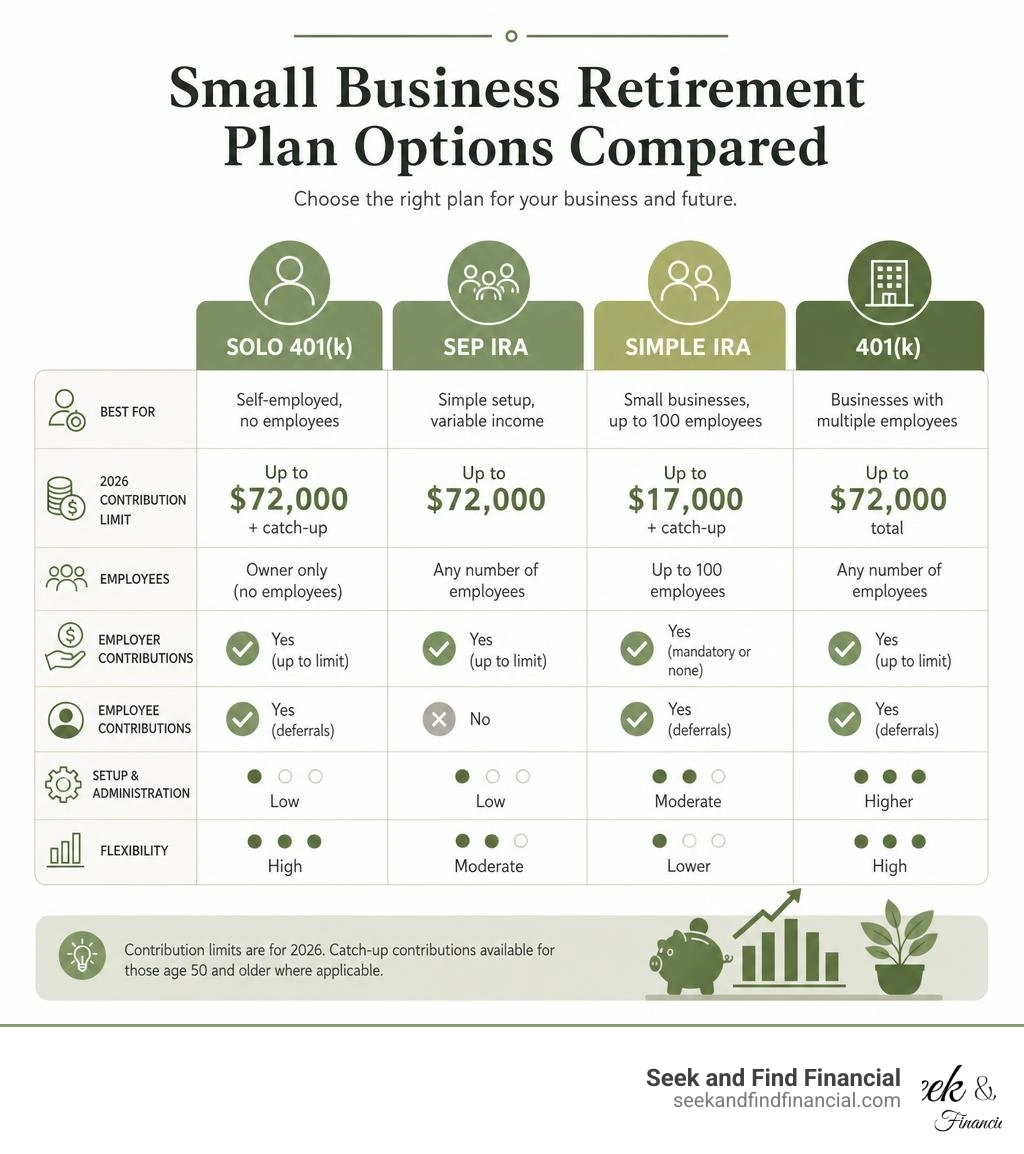
Here are the main options at a glance:
| Plan Type | Best For | 2026 Contribution Limit |
|---|---|---|
| Solo 401(k) | Self-employed, no employees | Up to $72,000 + catch-up |
| SEP IRA | Simple setup, variable income | Up to $72,000 |
| SIMPLE IRA | Small businesses, up to 100 employees | Up to $17,000 + catch-up |
| Traditional 401(k) | Businesses with multiple employees | Up to $72,000 total |
Each plan has different rules for contributions, employees, and taxes. The right one depends on your business structure, income, and goals.
If you earn $400K or more, the plan you choose isn't just about saving for retirement. It's one of the most powerful tax tools available to you. Getting it wrong means leaving real money on the table every year.
I'm Daniel Delaney, Founder of Seek & Find Financial. My career began at established financial institutions where I built a deep foundation in retirement planning and investment strategy, and I now apply that experience to help business owners choose and optimize retirement plans for business owners that align with their tax situation and long-term goals. In this guide, I'll walk you through every major option clearly and without the jargon.
Investing involves risk, including possible loss of principal. No investment strategy can ensure financial success or guarantee against losses. Past performance may not be used to predict future results. Provided content is for overview and informational purposes only, reflect the opinions of the author, and is not intended and should not be relied upon as individualized tax, legal, fiduciary, or investment advice.
This information is being provided only as a general source of information. These views may change as market or other conditions change. This information is not intended and should not be used to provide financial advice and does not address or account for an individual's circumstances. Past performance does not guarantee future results and no forecast should be considered a guarantee. Please seek the guidance of a financial professional regarding your particular financial concerns.
Investment advisory services offered by duly registered individuals through Seek & Find Financial LLC a Registered Investment Adviser. Licensed Insurance Professional
Many business owners believe their business is their retirement plan. They think they will sell the business one day and live off the cash. This is a very common mistake.
Selling a business is not a sure thing. Valuations can drop, buyers can disappear, or your health might force you to step away early. If all your wealth is tied up in your company, you are taking a massive risk. We help clients from Valparaiso, Chesterton, and Chicago build personal wealth outside of their business. This gives you real freedom and security.
A dedicated retirement strategy lets you build a personal liquidity reserve. This means you have cash and investments that do not depend on your business. If your business has a bad year, your personal life does not have to suffer.
Setting up a plan also helps you save on taxes today. When you earn a high income, your tax bracket can take a huge bite out of your earnings. By using tax-advantaged accounts, you can lower your taxable income right now. The money you save can grow tax-deferred for decades.
To learn more about how this fits into your overall life, read our Business Owner Financial Planning Guide and check out our Retirement Planning Entrepreneurs Guide. You can also read about the risks of relying only on a business sale in this article: Your Business Is Your Retirement Plan? That's the Million-Dollar Mistake. Open a Solo 401(k) Before December 31 - 24/7 Wall St. .
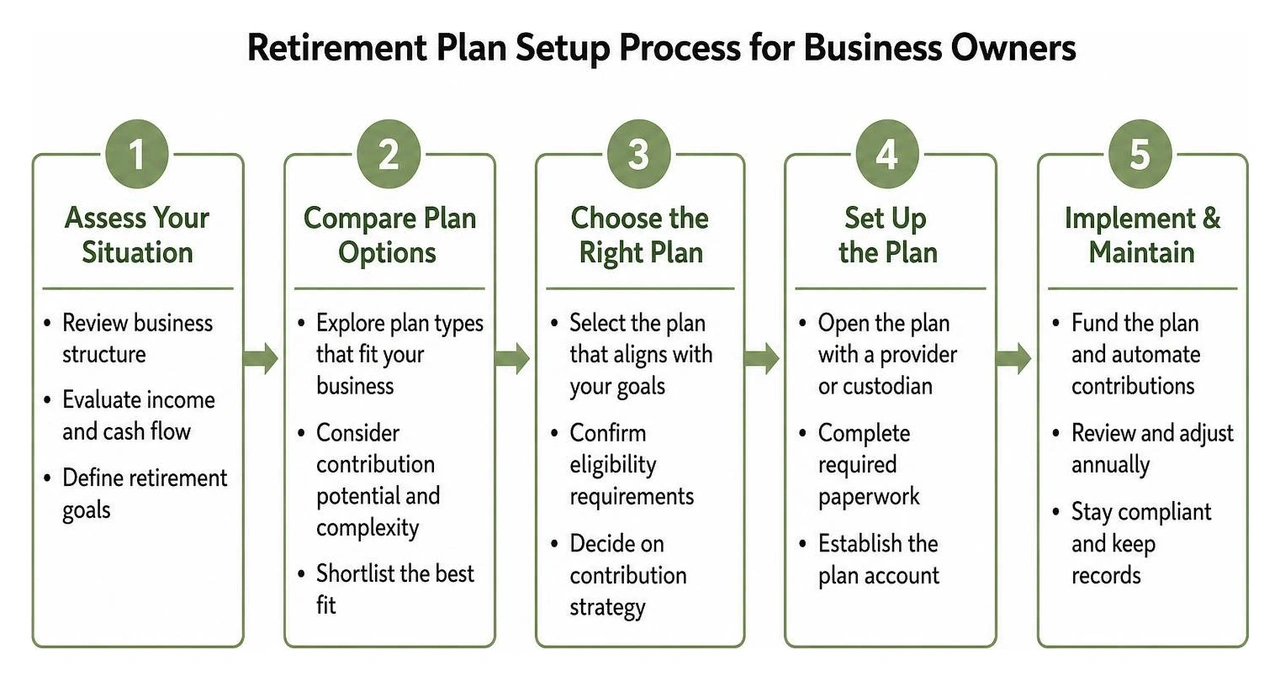
Finding the right plan depends on your business size, your cash flow, and your goals. Some plans are very simple to set up but have lower contribution limits. Other plans let you save much more but require more paperwork and higher fees.
Here is a simple framework to help you compare your options:
If you have no employees other than a spouse, the Solo 401(k) is often the best choice. This plan is also known as an Individual 401(k) or Self-Employed 401(k). It is a profit-sharing plan with a salary deferral arrangement.
The Solo 401(k) lets you save as both the employee and the employer. This "double-bucket" system allows you to reach high contribution limits even at lower income levels.
For 2026, here is how the contributions work:
If you are age 50 or older, you can add a catch-up contribution. For 2026, the standard catch-up is $8,000. If you are age 60, 61, 62, or 63, the catch-up limit is even higher at $11,250.
Another great feature is spouse participation. If your spouse works in the business and earns a salary, they can make their own employee and employer contributions. This can effectively double your household savings rate.
To set up a Solo 401(k), you must adopt a written plan document. You can learn more about how to calculate these contributions on the IRS website: Self-employed individuals: Calculating your own retirement plan contribution and deduction | Internal Revenue Service .
You can also explore specific provider options like the Solo 401(k) Plan | Maximize Retirement Savings | Fidelity Investments and read our Entrepreneur Retirement Plan guide.
If your business has common-law employees, you cannot use a Solo 401(k). You must look at other options that cover your staff.
A SEP IRA is very easy to set up and has low administrative costs. The business owner makes all the contributions. Employees do not contribute.
You can contribute up to 25% of each eligible employee's compensation, up to a maximum of $72,000 for 2026. The catch is that you must contribute the exact same percentage for all eligible employees. If you want to put 25% of your pay into your own account, you must also put 25% of your employees' pay into their accounts. This can get very expensive if you have multiple staff members.
A SIMPLE IRA is designed for businesses with up to 100 employees. It is much cheaper and easier to run than a traditional 401(k).
In 2026, employees can make salary reduction contributions of up to $17,000. If they are age 50 or older, they can make a catch-up contribution of up to $4,000.
As the employer, you must choose one of two matching options:
A traditional 401(k) is the most flexible plan, but it is also the most complex. It allows for high contribution limits and can include Roth options.
However, traditional 401(k) plans require annual compliance testing. This is called nondiscrimination testing. It ensures that business owners and high earners do not benefit unfairly compared to rank-and-file employees. To avoid this testing, many owners use a Safe Harbor 401(k) design, which requires a mandatory employer contribution. Traditional 401(k) plans also require filing Form 5500 with the government every year.
For more details on these choices, read our guide on Retirement Savings Plans for Small Business Owners and look into a Low Cost 401k for Small Business. You can also find local resources for business owners in Indiana and Illinois through Indiana & Illinois Individual Retirement - Rosenwinkel Insurance and find general advisory details on Business Owners - Mark De St. Jean - Valparaiso, IN or Financial Advisor in Chesterton, Indiana .
If your business is highly profitable and you want to save more than $72,000 a year, standard plans might not be enough. This is where advanced tax planning comes in.
A cash balance plan is a type of defined benefit plan. It acts like a pension, but it shows your balance as a single dollar amount.
These plans allow for very high contributions. The limits are based on your age and income, not a flat dollar cap. For 2026, the annual benefit limit increases to $290,000. If you are over age 50 and earn a high income, you can often contribute $100,000 to $300,000 per year. These contributions are fully tax-deductible for your business.
Many high-earning business owners in the Chicago and Merrillville areas combine a cash balance plan with a Solo 401(k). This is called a paired plan. It allows you to maximize your tax deductions and build wealth very quickly.
To understand how these advanced strategies work, read our articles on the Cash Balance Plan and Retirement Plans for High Earners. You can also review the official rules in Publication 560 (2025), Retirement Plans for Small Business | Internal Revenue Service .
The SECURE 2.0 Act brought major changes to retirement plans. If you are choosing a plan in 2026, you need to know how these laws affect you.
These updates mean your plan needs to be monitored regularly. A strategy that worked a few years ago might not be the most tax-efficient choice today.
To keep up with these changes, read our Simple IRA Complete Guide 2026 and look at the Department of Labor resources on Small Business Retirement Plan Options . You can also find information on corporate options through Corporate Retirement Plans - Ilya Yeverovich - Chicago, IL .
The Solo 401(k) is usually the best choice. It has the highest contribution limits because you can save as both employee and employer. It also allows your spouse to participate. It is simple to run, and you do not have to file Form 5500 until your total plan assets exceed $250,000.
In 2026, the limits have increased to match inflation:
Under the SECURE Act, you can establish a plan up to your business's tax filing deadline, including extensions, and still make employer contributions for that tax year. However, if you want to make employee salary deferrals to a Solo 401(k), the plan document must be established by December 31 of the tax year.
Choosing the right retirement plan is a critical step for your business and your personal future. At Seek & Find Financial, we specialize in helping business owners earning $400K+ navigate these choices. We use advanced, technology-driven planning tools like Altruist to build personalized wealth and tax strategies. We serve clients across Valparaiso, Chesterton, Portage, Hebron, Merrillville, Crown Point, Hobart, and Chicago.
Ready to build a clear, structured plan for your wealth? Learn more about our approach to Retirement Plans and let us help you keep more of what you earn.
Investing involves risk, including possible loss of principal. No investment strategy can ensure financial success or guarantee against losses. Past performance may not be used to predict future results. Provided content is for overview and informational purposes only, reflect the opinions of the author, and is not intended and should not be relied upon as individualized tax, legal, fiduciary, or investment advice.
This information is being provided only as a general source of information. These views may change as market or other conditions change. This information is not intended and should not be used to provide financial advice and does not address or account for an individual’s circumstances. Past performance does not guarantee future results and no forecast should be considered a guarantee. Please seek the guidance of a financial professional regarding your particular financial concerns.
Investment advisory services offered by duly registered individuals through Seek & find Financial LLC a Registered Investment Adviser. Licensed Insurance Professional