

Why Business Owner Tax Planning is Your New Best Friend
Master business owner tax planning: Defer income, claim Section 179, max retirement & save big on taxes!

Business owner tax planning is the process of making smart decisions all year. It helps you legally pay less in taxes. It lets you keep more of what you earn. Here are the main strategies that help the most:
Most business owners pay more tax than they need to. This happens because they do not have a clear plan.
The tax code has many tools for business owners who plan ahead. These tools only work if you use them at the right time. You also need the right business setup.
This guide will help you.
I am Daniel Delaney. I am the founder of Seek & Find Financial. I have spent my career as a financial advisor. I built a strong foundation in investment planning and wealth strategy. This experience helps me with business owner tax planning for my clients today. In the next sections, I will show you the best steps for 2026.
Investing involves risk, including possible loss of principal. No investment strategy can ensure financial success or guarantee against losses. Past performance may not be used to predict future results. Provided content is for overview and informational purposes only, reflect the opinions of the author, and is not intended and should not be relied upon as individualized tax, legal, fiduciary, or investment advice.
This information is being provided only as a general source of information. These views may change as market or other conditions change. This information is not intended and should not be used to provide financial advice and does not address or account for an individual's circumstances. Past performance does not guarantee future results and no forecast should be considered a guarantee. Please seek the guidance of a financial professional regarding your particular financial concerns.
Investment advisory services offered by duly registered individuals through Seek & Find Financial LLC a Registered Investment Adviser. Licensed Insurance Professional

One of the easiest ways to lower your tax bill is to control when money moves in and out of your business. This is a huge part of business owner tax planning. Most small businesses use the cash method of accounting. This means you record income when you get the check and record expenses when you pay the bill.
If you expect to be in a lower tax bracket next year, you might want to defer your income. You can do this by waiting until January to send out your December invoices. If you don't get the money until the new year, you don't have to pay taxes on it this year. On the other side, you can accelerate your deductions. This means you pay for things like office supplies, rent, or utilities before December 31. This lets you take the deduction right now.
We also look at how you handle employee costs. Reimbursing employees through an accountable plan is a great move. This allows your business to deduct these costs, but your employees do not have to pay taxes on the money they get back. You can learn more about this in IRS Publication 463 on Accountable Plans.
Year end is also the time to look at your team. If you plan to pay employee bonuses, make sure the money actually leaves your bank account by December 31. For businesses using the cash method, you can only deduct what you actually paid. We also suggest checking your inventory. If you have items that are old or broken, you can write off that obsolete inventory to get an immediate deduction. Finally, don't forget about bad debts. If a client hasn't paid you and you know they never will, you might be able to write that off too.
If you need to buy big items for your business, now is a great time. A new law called the One Big Beautiful Bill Act (OBBBA) has changed the game for business owner tax planning. This law brought back 100% bonus depreciation. This means you can often write off the entire cost of a new asset in the very first year you use it.
There is also Section 179. For the 2026 tax year, companies can immediately expense up to $2.56 million of qualifying purchases. This is a big jump from previous years. This deduction starts to go away only after you spend more than $4.09 million on equipment in a single year.
What counts as a qualifying asset? Many things you use every day:
By using these rules, you can turn a large purchase into a massive tax break. Instead of spreading the deduction over many years, you get the help now when you need it most.
Saving for retirement is one of the best ways to lower your taxes. Every dollar you put into a traditional retirement plan is a dollar you don't pay taxes on today. For high earning business owners in places like Crown Point or Chicago, this can save thousands of dollars every year.
Here is a quick look at the 2026 limits for common plans:
| Plan Type | 2026 Contribution Limit | Catch-up (Age 50+) |
|---|---|---|
| 401(k) | $24,500 | $12,000 |
| SIMPLE IRA | $17,000 | $3,500 |
| SEP IRA | Up to $70,000+ | N/A |
| HSA (Individual) | $4,400 | $1,000 |
| HSA (Family) | $8,750 | $1,000 |
We focus on helping you pick the plan that fits your goals. You can see more info about wealth management services to understand how these plans fit into a bigger picture.
If you have employees, you have to think about their limits and your employer match. The 401(k) is very popular because it has a high limit of $24,500. If you are 50 or older, you can add another $12,000. For those who work for themselves, a Solo 401(k) is often the best choice. It allows you to save as both the boss and the worker.
Thanks to the SECURE 2.0 Act, there are even more options now. Some plans now allow for Roth contributions, which means you pay tax now but the money grows tax free forever. This is a key part of long term business owner tax planning.
Don't overlook health benefits. A Health Savings Account (HSA) is often called the best tax deal in the country. It has a triple tax advantage. The money goes in tax free, it grows tax free, and you take it out tax free for health costs. For 2026, the limits are $4,400 for individuals and $8,750 for families.
If you offer a Flexible Spending Account (FSA), the limit is $3,400 for 2026. Just remember that FSA money is usually "use it or lose it" by the end of the year. If you pay for health insurance for your team, you might also qualify for the Small Business Health Care Tax Credit. This can cover a big part of your premium costs.
The way you set up your business matters. An LLC, S-Corp, or C-Corp all pay taxes differently. As your business grows, your old structure might not be the best fit anymore. For example, many owners in Merrillville or Valparaiso find that an S-Corp helps them save on self employment taxes.
There are also new rules for 2026 to keep in mind:
We also look for tax credits. A credit is better than a deduction because it lowers your tax bill dollar for dollar. You might qualify for R&D credits if you are making new products. If you hire people from certain groups, you can claim the Work Opportunity Tax Credit.
One smart move is hiring your children. If they do real work for the business, you can pay them a fair wage. This moves income from your high tax bracket to their very low bracket. It is a great way to save for their future while lowering your current taxes.
The IRS wants their money throughout the year, not just in April. If you don't pay enough in estimated taxes, you could face big penalties. Businesses that don't get professional help are 50% more likely to face these IRS penalties, according to a Thomson Reuters 2025 report on tax penalties.
To avoid this, we use technology. AI tools and modern software can help us track your income in real time. We use platforms like Altruist to keep your financial life organized. These tools can flag potential deductions we might have missed and predict how much you will owe.
Good recordkeeping is the foundation of business owner tax planning. If you have clear digital records, you don't have to worry if the IRS asks questions. Automation makes this easy. Instead of a box of receipts, everything is tracked and filed as it happens.
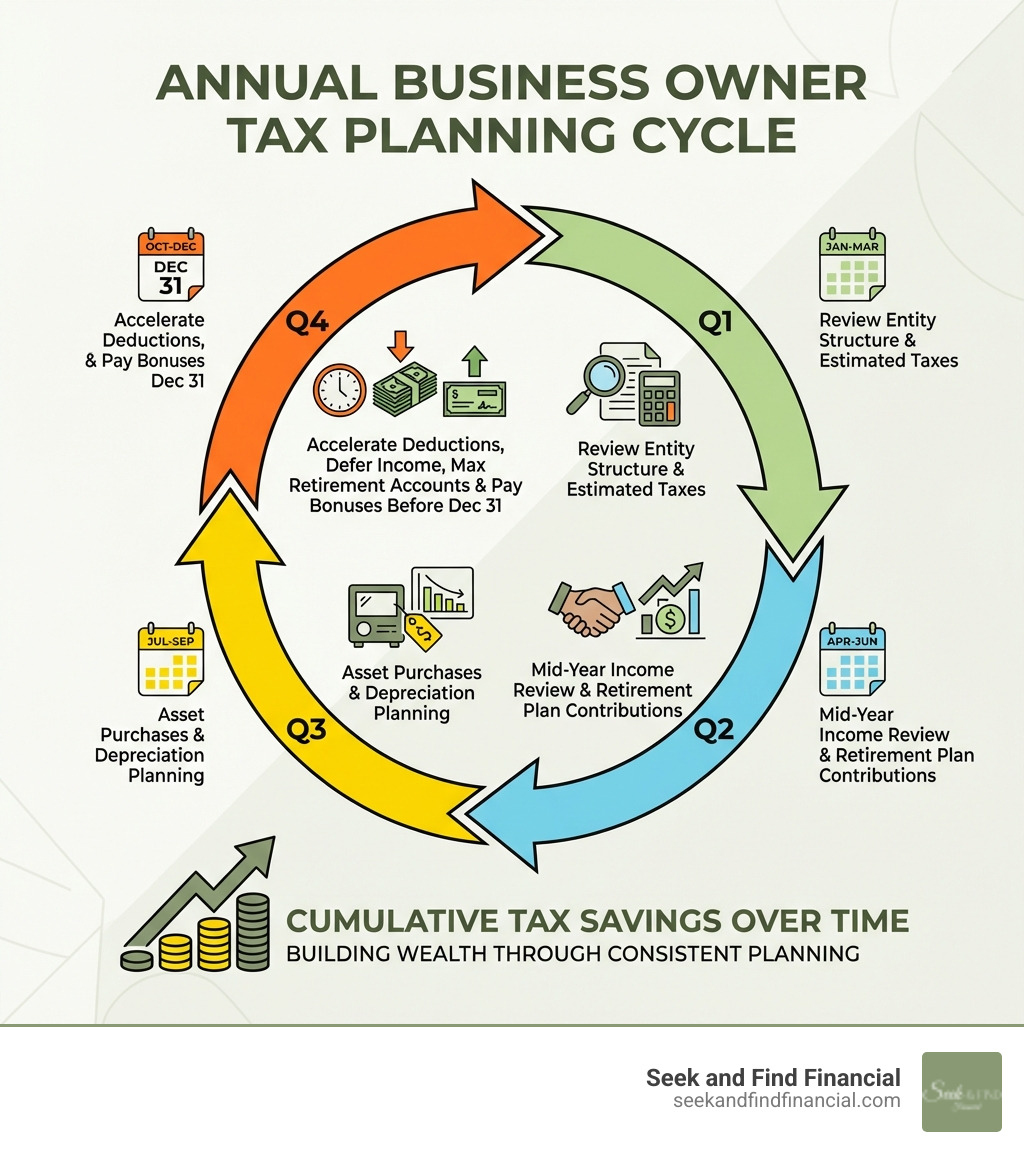
The best time is right now. While many people wait until the end of the year, the most successful owners plan every month. This allows you to adjust your estimated payments and make big purchases when it makes the most sense for your cash flow.
When you hire your child, the wages you pay them are a deductible business expense. If your child is under 18 and you are a sole proprietor or a partnership, you might not even have to pay Social Security or Medicare taxes on their wages. It's a legal way to keep more money in the family.
Yes, if you use a part of your home exclusively for business. You can use the simplified method, which is $5 per square foot up to 300 square feet. Or, you can track your actual costs like utilities and insurance. This is a common deduction for business owners in our area.
Planning for taxes shouldn't be something you do once a year in a panic. It is a system that helps you grow your wealth over time. By choosing the right structure, timing your expenses, and using the latest laws like the OBBBA, you can keep more of your hard earned money.
At Seek & Find Financial, we focus on the unique needs of owners earning $400K+. We use tools like Altruist to give you a clear, personalized plan. We don't believe in generic advice. We believe in strategic decisions that help you reach your goals. If you want to see how a structured plan can help you, take a look at more info about our financial planning services.
Investing involves risk, including possible loss of principal. No investment strategy can ensure financial success or guarantee against losses. Past performance may not be used to predict future results. Provided content is for overview and informational purposes only, reflect the opinions of the author, and is not intended and should not be relied upon as individualized tax, legal, fiduciary, or investment advice.
This information is being provided only as a general source of information. These views may change as market or other conditions change. This information is not intended and should not be used to provide financial advice and does not address or account for an individual’s circumstances. Past performance does not guarantee future results and no forecast should be considered a guarantee. Please seek the guidance of a financial professional regarding your particular financial concerns.
Investment advisory services offered by duly registered individuals through Seek & find Financial LLC a Registered Investment Adviser. Licensed Insurance Professional