

The Best Financial Planners for Personal Budgeting Success
Master financial advisor budget planning: Build budgets, track expenses, and achieve wealth with proven strategies and tools for high-earners.

Financial advisor budget planning is the process of working with a professional to create a structured spending and savings strategy that aligns with your income, goals, and long-term wealth objectives. Here's what effective budget planning delivers:
Many high-earning professionals find that generic budgeting advice doesn't work for their complex financial lives. When you're making $400K or more annually, you're not just managing expenses. You're balancing business income, tax strategies, retirement contributions, investment portfolios, and long-term wealth planning. A financial advisor who specializes in budget planning helps you see the full picture and make decisions that protect and grow your wealth over time.
Budgeting is not about restriction. It's about control. Studies show that tracking where money goes reduces financial stress and increases stability. It helps you prepare for emergencies, pay down debt faster, and free up capital for strategic investing. Without a clear plan, even high earners can feel like they're running on a treadmill, making a lot but not building the wealth they expect.
A personalized budget also reveals opportunities. You might discover you're overpaying in taxes, holding too much cash that could be invested, or missing employer matches on retirement accounts. These are the kinds of insights that come from working with someone who understands both your day-to-day spending and your 10-year financial strategy.
I'm Daniel Delaney, founder of Seek & Find Financial, and I've spent years helping individuals and families build clear, disciplined financial strategies. My experience working within established financial institutions and now leading an independent firm has shown me the value of structured financial advisor budget planning as the foundation for long-term wealth success.
Many people think budgeting is only for those struggling to pay bills. This is a myth. For our clients in Valparaiso, Chesterton, and Chicago, budgeting is a tool for power. It is about making sure your money goes where you want it to go.
When you earn a high income, it is easy to ignore small costs. But those costs add up. For example, spending just $3 a day on coffee costs more than $1,000 a year. If you are not careful, "lifestyle creep" can eat your raises and bonuses before you can invest them.
Working with us on your budget helps reduce financial stress. Even if you make $400,000 a year, you might feel stress if you do not have a clear plan. We help you build stability. This starts with a solid emergency fund. We also focus on debt reduction. High-interest debt can cost you thousands in interest every year. By creating a plan, we can help you pay that off and move that money into wealth-building accounts.
Effective How to Develop a Financial Plan starts with understanding your cash flow. We want to see how much is coming in and exactly how much is going out. This gives us a baseline to build your future.
To get a clear picture, we break your spending into groups. This makes it easier to see where we can make changes.
A financial advisor does more than just track numbers. We provide a personalized strategy. For business owners in Crown Point or Hobart, your personal budget and business budget are often linked. We help you separate them.
We also look at tax efficiency. If you are in a high tax bracket, how you save matters. We can help you decide if you should put more into a 401(k) or a taxable account.
We use tools like the Budget Planner tool to help you visualize your progress. Our goal is to make sure your spending today does not steal from your wealth tomorrow.
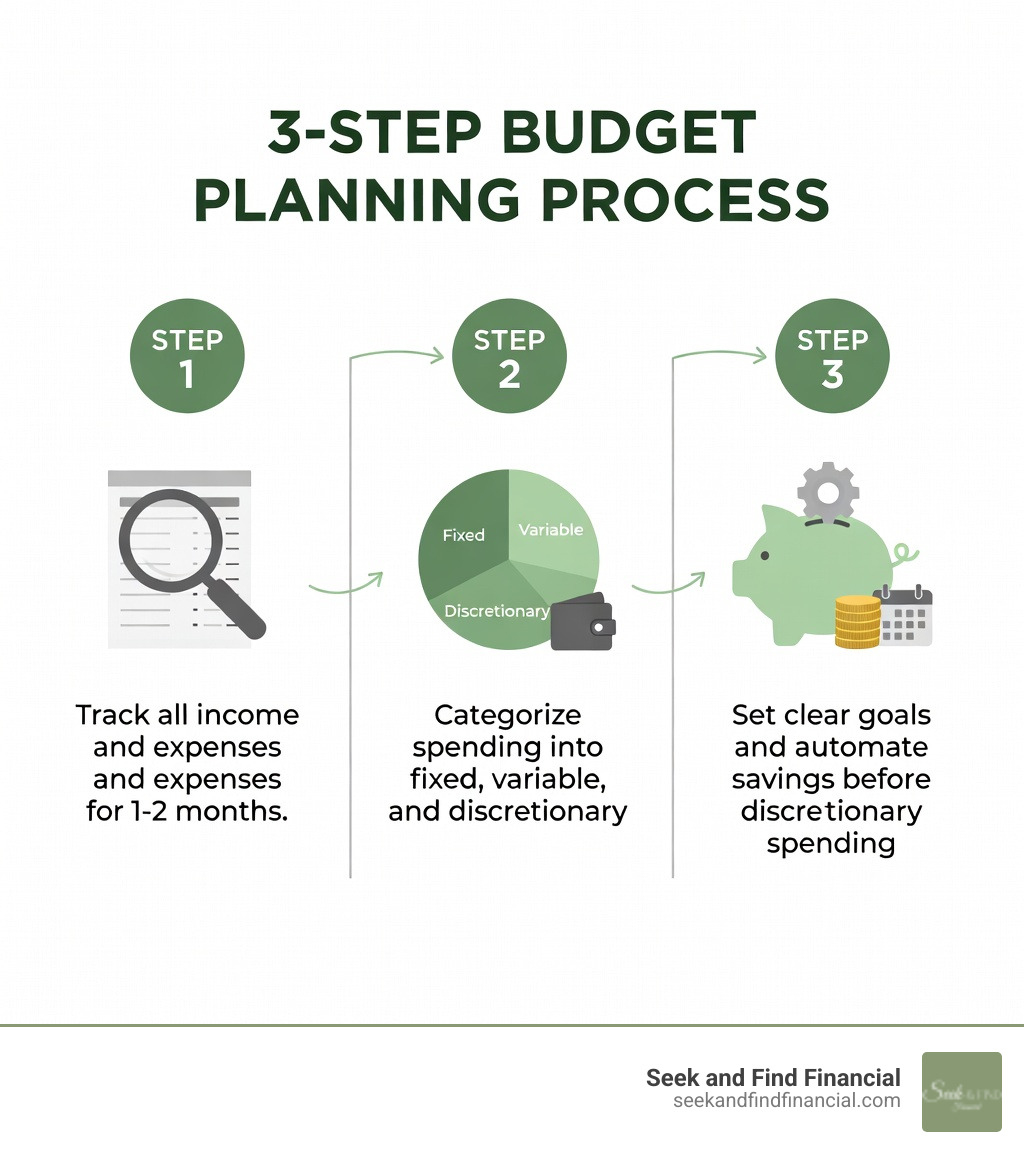
Building a plan is a step-by-step process. It is not something you do once and forget. It is a living document.
First, we look at your net income. This is your "take-home" pay after taxes and deductions. If you are an entrepreneur with variable income, we look at your averages. We want to be realistic. It is better to under-estimate your income than to over-estimate it.
Next, we track your expenses. We suggest doing this for at least one or two months. You can use apps or spreadsheets. This is often an eye-opener. Many families have no idea what they actually spend until they see it in writing.
Then, we set goals. Writing down your goals makes them more likely to happen. We look at short-term goals, like a new car or a home renovation in Merrillville. We also look at long-term goals, like retirement or paying off a mortgage early.
Once we have the data, we compare your income to your expenses. If you are spending more than you make, we find ways to cut back. We usually start with discretionary items. It is often easier to cut spending than to increase income quickly.
Finally, we implement the "Pay Yourself First" rule. This is the golden rule of finance. We set up automatic transfers so that your savings and investments are taken out before you have a chance to spend them.
There is no "one size fits all" budget. We help you find the method that fits your personality.
The 50/30/20 rule is very popular. You put 50 percent of your income toward needs. 30 percent goes to wants. The last 20 percent goes to savings and debt repayment. For high earners, we often suggest aiming for a higher savings rate, such as 30 or 40 percent.
Zero-based budgeting means every dollar has a job. If you make $20,000 this month, you decide where every single cent goes until there is zero left over. This is great for people who want total control.
The envelope system is an old-school method. You put cash into envelopes for different categories. When the envelope is empty, you stop spending in that category for the month. Today, we can do this digitally with certain apps.
| Feature | 50/30/20 Rule | Zero-Based Budgeting |
|---|---|---|
| Best For | People who want a simple guide | People who want total control |
| Flexibility | High flexibility | Low flexibility |
| Time Needed | Low | High |
| Goal Focus | Balanced | Very specific |
In our firm, we believe in using technology to make your life easier. We use Altruist to provide you with a clear, real-time look at your wealth. You should not have to log into ten different websites to see your money.
Digital dashboards allow us to see your spending as it happens. We can set up automated transfers. This means your money moves to your savings, your 401(k), and your bills without you lifting a finger.
We go beyond basic apps. We use tools that integrate your spending with your investments. This helps us see how a small change today affects your retirement in twenty years.
Our secure portals allow you to see your progress on your phone or computer. Whether you are at home in Hebron or working in Chicago, you always know where you stand. This real-time data helps us make better decisions together.
Budgeting is the fuel for your long-term dreams. It supports retirement planning. We often recommend saving at least 15 percent of your pre-tax income for retirement. This includes any employer match, which is basically "free money."
Budgeting also helps with debt consolidation. If you have multiple loans, a budget helps us see which one to pay off first. We also use it to build your emergency savings. We want you to have enough cash to cover 3 to 6 months of expenses. This prevents you from having to sell investments if the market is down or if you have a business setback.
For many of our clients, a big goal is paying off their mortgage. By tracking your spending, we can find extra money to put toward your principal. This can save you tens of thousands of dollars in interest over time.
We generally recommend saving 15 percent of your pre-tax income. If you started saving later in life, you may need to save more. We help you run the numbers to see what your specific "number" is.
It is a simple way to split your income. 50 percent goes to needs (housing, groceries), 30 percent to wants (hobbies, dining out), and 20 percent to savings and debt. It is a great starting point for many families.
Most experts suggest 3 to 6 months. If you are a business owner with variable income, we might suggest 6 to 12 months. This gives you a "runway" so you do not have to worry during slow months.
At Seek & Find Financial, we know that financial advisor budget planning is about more than just numbers. It is about your life. It is about having the freedom to enjoy your success today while building a legacy for tomorrow.
Whether you are in Valparaiso, Crown Point, or Chicago, we are here to help you find clarity. We provide a personalized, technology-driven plan that fits your real life. Let's work together to make sure every dollar you earn is working as hard as you do.
Investing involves risk, including possible loss of principal. No investment strategy can ensure financial success or guarantee against losses. Past performance may not be used to predict future results. Provided content is for overview and informational purposes only, reflect the opinions of the author, and is not intended and should not be relied upon as individualized tax, legal, fiduciary, or investment advice.
This information is being provided only as a general source of information. These views may change as market or other conditions change. This information is not intended and should not be used to provide financial advice and does not address or account for an individual’s circumstances. Past performance does not guarantee future results and no forecast should be considered a guarantee. Please seek the guidance of a financial professional regarding your particular financial concerns.
Investment advisory services offered by duly registered individuals through Seek & find Financial LLC a Registered Investment Adviser. Licensed Insurance Professional