

What Does a Financial Advisor Do and Do You Really Need One?
Discover what a financial advisor does what to grow and protect your wealth—plus when you really need one.
Understanding financial advisor does what for your money is simpler than most people expect. Here is a quick answer:
A financial advisor helps you with:
That is the short version. The full picture is more nuanced, and for high earners with complex financial lives, the details matter a great deal.
Most people assume a financial advisor is simply someone who picks stocks. That is a small part of the job. According to a 2024 Vanguard study, advisors who provide comprehensive services add an estimated 1.5% to 3% in net annual return above what investors typically achieve on their own. Much of that gain does not come from better stock picks. It comes from smarter tax decisions, better withdrawal sequencing, and preventing costly emotional mistakes.
Americans who work with a financial advisor also expect to retire two years earlier and have saved more than twice as much for retirement compared to those without one, according to Northwestern Mutual's 2024 Planning and Progress Study.
The financial world involves a lot of moving parts. Retirement accounts, tax law, estate documents, insurance coverage, equity compensation, and investment risk all interact with each other. A good advisor coordinates all of it so your decisions work together instead of against each other.
I'm Daniel Delaney, Founder of Seek & Find Financial, and I've spent my career in financial services working within established institutions before launching an independent firm built around transparency and long-term client relationships. My hands-on experience advising individuals and families on exactly what a financial advisor does across investments, retirement, taxes, and risk management shapes every strategy I build with clients. The sections below break down each area in clear, practical terms so you know what to expect and what to look for.
Investing involves risk, including possible loss of principal. No investment strategy can ensure financial success or guarantee against losses. Past performance may not be used to predict future results. Provided content is for overview and informational purposes only, reflect the opinions of the author, and is not intended and should not be relied upon as individualized tax, legal, fiduciary, or investment advice.
This information is being provided only as a general source of information. These views may change as market or other conditions change. This information is not intended and should not be used to provide financial advice and does not address or account for an individual's circumstances. Past performance does not guarantee future results and no forecast should be considered a guarantee. Please seek the guidance of a financial professional regarding your particular financial concerns.
Investment advisory services offered by duly registered individuals through Seek & Find Financial LLC a Registered Investment Adviser. Licensed Insurance Professional
Handy financial advisor does what terms:
When you look at your overall wealth, a comprehensive financial advisor acts as the lead coordinator. Think of your money as a business. You would not let your sales department make decisions without talking to your tax department. In the same way, your investments should never be managed without looking at your tax return.
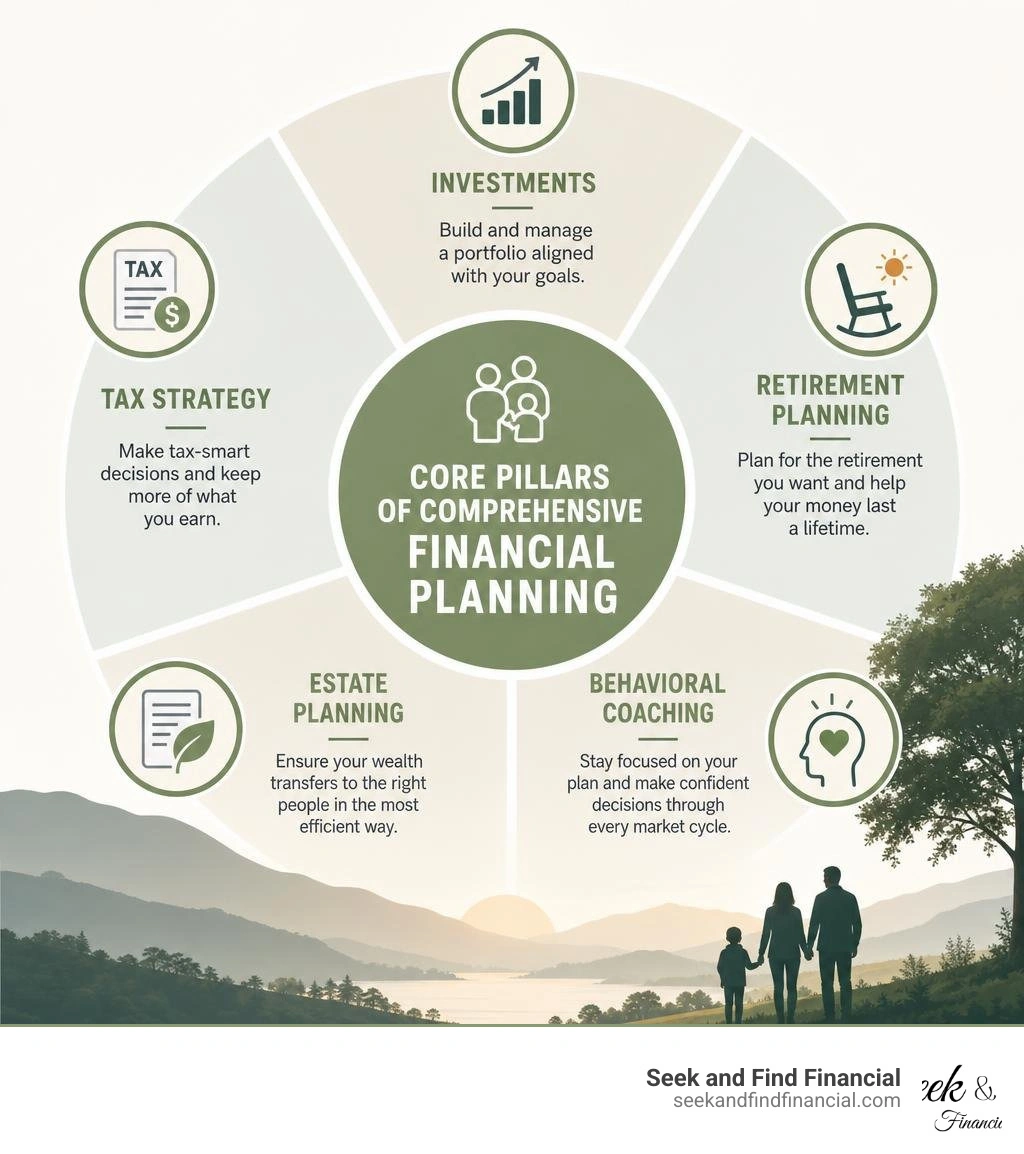
An advisor looks at your entire financial life. We look at what you earn, what you spend, what you owe, and what you own. From there, we build a structured plan to grow your wealth. This includes selecting the right mix of investments, such as low cost index funds. It also means matching those investments to your personal comfort with risk.
A major part of what we do is behavioral coaching. When the stock market drops, it is natural to feel stressed. Many investors make the mistake of selling their investments during a downturn. An advisor provides historical perspective. We help you stay calm and stick to your long term plan.
We also coordinate your tax strategy. This means finding ways to lower your tax bill today and in the future. We look at your retirement accounts, taxable brokerage accounts, and business structures. We make sure they are set up to keep more money in your pocket. Finally, we coordinate with estate planning professionals. This ensures your hard work benefits the people and causes you care about most.
To learn more about how these services fit together, you can read this guide on What Does a Financial Advisor Do? | Expertise.com.
Building wealth is only half of the battle. You also have to protect it. A single unexpected event can wipe out years of hard work if you do not have the right safeguards in place.
An advisor reviews your risk management needs. This means looking at your insurance coverage. We evaluate your life insurance, disability insurance, and liability coverage. We do not sell you products you do not need. Instead, we make sure you have the right amount of protection to keep your family safe.
We also focus on debt reduction and cash flow coaching. If you carry high interest debt, it acts as a drag on your wealth. We help you build a clear strategy to pay down debt quickly. We also look at your cash flow. We help you automate your savings so you build wealth without having to think about it every single day.
For a closer look at how we tailor these protection strategies for our clients, read our guide on Personalized Financial Planning.
Transitioning from saving money to spending money is a major psychological shift. When you stop receiving a regular paycheck, you need a reliable system to replace that income.
An advisor helps you navigate this transition. We look at your various income sources. This includes pensions, retirement accounts, and Social Security. We help you decide the best age to claim Social Security benefits. Claiming at age 62, 67, or 70 can dramatically change your lifetime payout.
We also build a withdrawal sequencing plan. This determines which accounts you should take money from first. For example, withdrawing from taxable accounts, traditional IRAs, and Roth IRAs in the wrong order can trigger massive tax bills. By sequencing these withdrawals correctly, we can help extend the life of your portfolio.
We also use advanced strategies like tax-loss harvesting and Roth conversions. These tools help minimize your lifetime tax liabilities. They also protect you against longevity risk, which is the risk of outliving your savings.
To understand how we manage this complex process, explore our article on the role of a Financial Management Advisor.
Not all financial professionals are held to the same legal standard. This is one of the most important things to understand before you hire anyone to manage your money.
A fiduciary advisor is legally required to act in your best interest at all times. They must put your needs ahead of their own. They must disclose any potential conflicts of interest. They are usually paid through a transparent fee, rather than by selling financial products.
A non-fiduciary advisor operates under a different standard. They are often held to a suitability standard or Regulation Best Interest (Reg BI). Under this standard, they only have to recommend products that are suitable for you at the time of the sale. They can legally recommend a higher cost product that pays them a larger commission, even if a lower cost option is available.
Key differences include:
To learn more about the official government descriptions and tasks of personal financial advisors, you can visit the 13-2052.00 - Personal Financial Advisors page.
Because anyone can call themselves a financial planner, you should look for specific credentials. These show that an advisor has met rigorous education and experience standards.
The gold standard for financial planning is the Certified Financial Planner (CFP) designation. To earn this, an advisor must complete college level coursework, pass a difficult exam, and document thousands of hours of real world experience. They must also sign a strict fiduciary pledge.
Other valuable credentials include the Chartered Financial Analyst (CFA) designation. This is highly respected for deep investment analysis. If you need advanced tax planning, look for a Certified Public Accountant (CPA) who specializes in financial planning.
To understand why these credentials matter, read our detailed article on choosing a Certified Financial Advisor.
How an advisor gets paid directly impacts the advice they give you. There are three primary compensation models in the financial industry:

At Seek & Find Financial, we believe in complete transparency. We use modern technology platforms like Altruist to keep investment costs low and fee structures clear.
Is working with an advisor worth the cost? The answer depends on your financial complexity.
As mentioned earlier, Vanguard research shows that a comprehensive advisor can add significant value. This value does not come from trying to beat the stock market. It comes from structured wealth planning.
The biggest driver of poor investment returns is human behavior. When the market experiences volatility, investors often panic. They sell near the bottom and buy back in near the top. An advisor acts as a barrier between your emotions and your money. This behavioral coaching alone can save you from devastating financial mistakes.
For a deeper dive into how professional guidance can protect your wealth, read our Financial Advisor Executives Guide.
You do not need a financial advisor for every stage of your life. If you have a simple financial situation, you can likely manage it on your own.
However, life transitions often create high stakes moments. These are the times when professional guidance is highly valuable. Common triggers include:
If you are an entrepreneur or business owner, managing your business and personal finances together is critical. To learn more, read our guide on finding a Financial Advisor for Startups.
Your first meeting with a financial advisor should be a low pressure conversation. It is an opportunity to see if the advisor is a good fit for your personality and goals.
Before the meeting, you should gather your basic financial documents. This includes tax returns, account statements, and details about your debt. During the consultation, the advisor will ask about your goals. They will want to know what you want your life to look like in five, ten, and twenty years.
You should also ask the advisor direct questions. Ask if they are a fiduciary 100% of the time. Ask exactly how they are paid and what services they provide.
To prepare for this meeting, you can read our Financial Advisor Consultation Guide 2026.
You can certainly invest on your own using simple index funds. However, investing is only one piece of the puzzle. Most self-directed investors struggle with complex tax laws, estate planning, and withdrawal strategies. If you do not have the time or interest to manage these details, a professional can help.
This varies by firm. Some traditional firms have account minimums of $1 million or more. Other modern firms use flat fees or subscription models to help clients who are still building their wealth. At Seek & Find Financial, we specialize in helping business owners and high income earners with complex financial needs.
To understand how different firms operate, read our overview of choosing a Financial Advisor Company.
We recommend meeting at least once or twice per year. These meetings are used to review your portfolio, update your tax strategy, and adjust your plan for any major life changes. You should also reach out to your advisor during major life events, such as selling a business or changing careers.
At its core, a financial advisor helps you turn financial complexity into clear, confident decisions. We build structured plans that look at your investments, taxes, and personal goals as a single system.
At Seek & Find Financial, we do not believe in generic, cookie cutter advice. We provide personalized, technology-driven wealth management for entrepreneurs, business owners, and families throughout Northwest Indiana and Chicago. Whether you are in Valparaiso, Chesterton, Portage, Crown Point, Hobart, or Merrillville, we are here to help you build a clear path forward.
If you are ready to stop guessing and start planning with clarity, we invite you to take the next step.
Discover our personalized wealth management services
Investing involves risk, including possible loss of principal. No investment strategy can ensure financial success or guarantee against losses. Past performance may not be used to predict future results. Provided content is for overview and informational purposes only, reflect the opinions of the author, and is not intended and should not be relied upon as individualized tax, legal, fiduciary, or investment advice.
This information is being provided only as a general source of information. These views may change as market or other conditions change. This information is not intended and should not be used to provide financial advice and does not address or account for an individual’s circumstances. Past performance does not guarantee future results and no forecast should be considered a guarantee. Please seek the guidance of a financial professional regarding your particular financial concerns.
Investment advisory services offered by duly registered individuals through Seek & find Financial LLC a Registered Investment Adviser. Licensed Insurance Professional