

From Startup to Success: Mastering Financial Management for Your Entrepreneurial Journey
Master financial management for entrepreneurs: Build budgets, master cash flow, secure funding, and drive startup success.

Financial management for entrepreneurs is the system of tracking income and expenses, managing cash flow, planning budgets, and making sound investment decisions to grow your business. It means knowing where your money is, where it's going, and how to use it strategically to build long-term wealth and stability.
Here's what effective financial management includes:
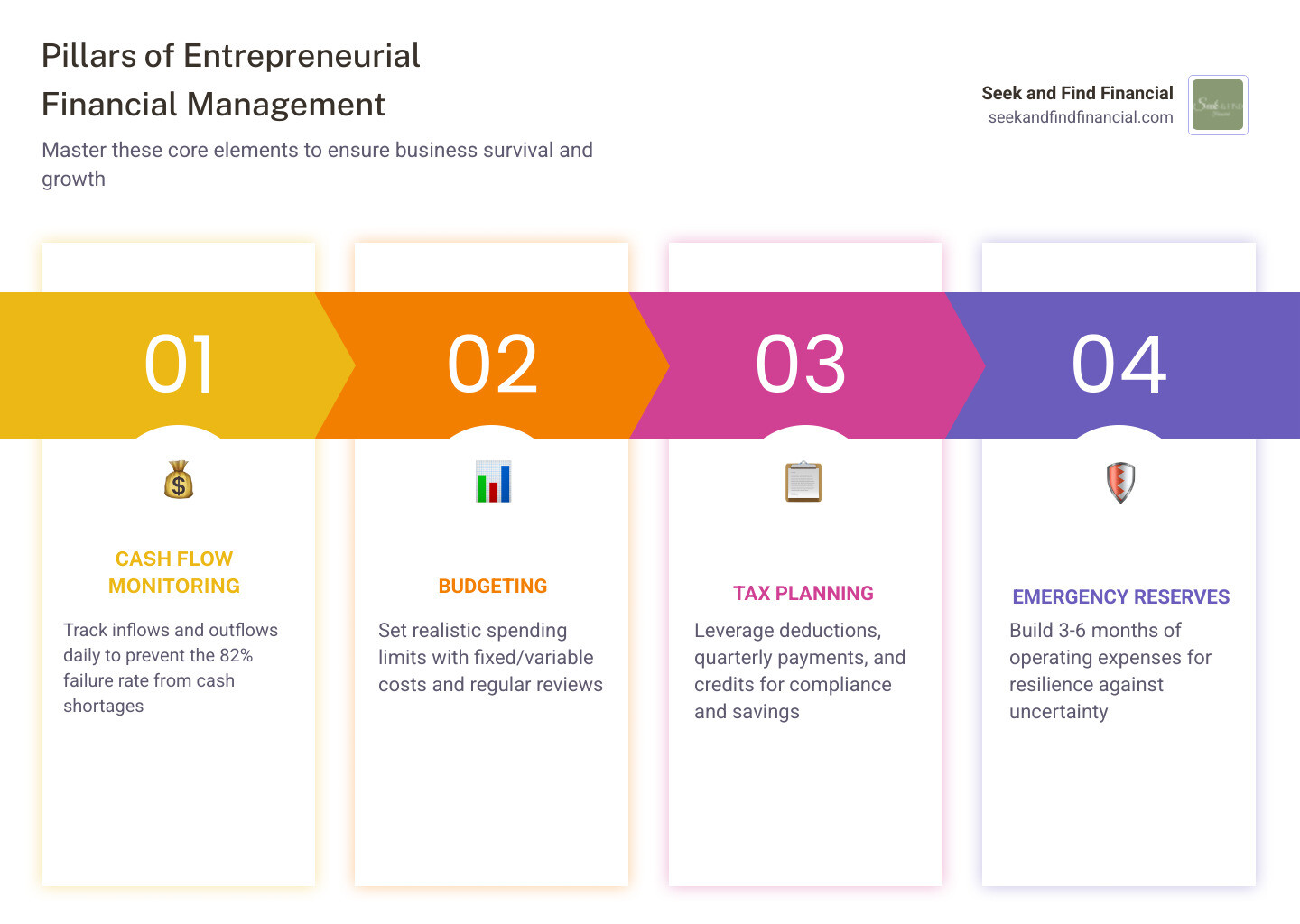
The stakes are high. Research shows that around 66% of entrepreneurs rely on their own money to fund their business initially. Nearly 28% keep their day job when first launching. And most critically, 82% of small businesses fail due to poor cash flow management.
This isn't just about keeping the lights on. It's about making strategic decisions that compound over time. Do you reinvest profits or take a draw? When do you hire? How much debt is too much? What insurance coverage protects your assets? These questions require structured thinking and clear financial visibility.
I'm Daniel Delaney, Founder and Owner of Seek & Find Financial, and I've spent years helping business owners and families build clear, confident financial strategies. Throughout my career at established firms and now as an independent advisor, I've seen how Financial management for entrepreneurs requires both discipline and flexibility to navigate growth, uncertainty, and opportunity.
Starting a business is like building a house. You need a strong foundation before you put up the walls. For an entrepreneur, that foundation is a solid business plan. This plan is your roadmap. It shows where you want to go and how you will pay for the trip.
A good plan includes financial projections. These are your best guesses for how much money you will make and spend. You should look at least three years into the future. We suggest making three versions: one where things go great, one where things go okay, and one where things go slow. This helps you prepare for anything.
You also need a personal survival budget. This is the smallest amount of money you need to pay your own bills. Many founders forget this. They focus so much on the business that they forget they need to eat and pay rent. About 28% of entrepreneurs keep their day job at first to cover these costs. This is a smart way to stay safe while you build.
To help you get started, you can Manage your finances with SBA resources. These tools help you understand the basics of small business money.
One of the biggest mistakes we see is mixing personal money with business money. It might seem easy to use one credit card for everything. But this creates a big mess later.
You should open a separate business bank account right away. Get a business credit card too. This makes your life much easier at tax time. It also gives you legal protection. If your business is an LLC or a corporation, keeping money separate helps protect your personal assets. If you mix the money, a court might say you and the business are the same. That means your personal house or car could be at risk if the business has trouble.
Clean bookkeeping also helps you see the truth. If you use business money for a personal dinner, your profit numbers will be wrong. You won't know if the business is actually making money or just paying for your lifestyle.
We believe in setting goals that actually work. We use the SMART method. This stands for Specific, Measurable, Achievable, Relevant, and Time-bound.
For entrepreneurs earning $400K or more, goals often shift. You might focus on saving for retirement or lowering your tax bill. Having clear milestones helps you stay on track when things get busy.

Cash flow is the lifeblood of your company. You can have a lot of sales and still go out of business. This happens because sales are not the same as cash in the bank. You might sell a product today but not get paid for 60 days. In the meantime, you still have to pay your workers and your rent.
Poor cash flow management is the reason 82% of small businesses fail. You need enough working capital to keep things running. This means having enough cash to cover your daily costs. Liquidity is the word for how fast you can turn assets into cash. High liquidity keeps your business safe.
To master your cash flow, you must track every dollar coming in and going out. Here are some tips we use with our clients:
Monitoring these numbers every week is part of good Financial management for entrepreneurs. It lets you see a problem before it becomes a crisis.
A budget is a plan for your spending. It should reflect the reality of your business, not just your hopes. Start by listing your fixed costs. These are things like rent and insurance that stay the same every month. Then list your variable expenses. These are things like marketing or supplies that change based on how much you sell.
Review your budget every month. Compare what you planned to spend with what you actually spent. If you are over budget, find out why. Maybe you are spending too much on software you don't use. Or maybe your shipping costs went up.
For more deep learning, check out this Financial management and business success guide. It explains how budgeting helps you make better decisions.
You don't need to be an accountant, but you must understand your financial statements. These papers tell the story of your business. There are three main ones you should know.
| Statement | What it Tells You | Why it Matters |
|---|---|---|
| Profit and Loss (P&L) | Your income minus your expenses over time. | Shows if you are making a profit. |
| Balance Sheet | What you own (assets) and what you owe (liabilities). | Shows the overall value of your business. |
| Cash Flow Statement | How cash moves in and out. | Shows if you have enough cash to pay bills. |
Taxes for entrepreneurs are more complex than for employees. You have to pay self-employment tax. You also have to make quarterly estimated payments to the IRS. If you wait until the end of the year to pay, you might get hit with a big bill and penalties.
Strategic tax planning is about more than just filing forms. It is about finding ways to keep more of what you earn. We look for tax deductions like home office costs, travel, and equipment. For high earners, we also look at retirement plan contributions. Putting money into a SEP IRA or a Solo 401(k) can lower your taxable income today while building wealth for tomorrow.
Once you understand your statements, you can use them to grow. A P&L statement helps you see which products make the most money. A balance sheet shows your debt levels. If you have too much debt, it might be hard to get a loan for a new project.
We look at financial ratios too. For example, the "current ratio" compares your assets to your debts. It tells us if you can pay your short-term bills. These numbers help us decide when it is safe to hire a new person or move to a bigger office.
How you fund your business matters. About 66% of founders use their own savings. This shows you have "skin in the game." It makes other investors trust you more. But using all your own money is risky.
Other options include:
Every business faces surprises. A machine might break. A big customer might leave. This is why you need an emergency fund. We recommend saving three to six months of operating expenses. Keep this money in a separate, high-yield savings account. It should be easy to get to but not part of your daily spending.
Insurance is also a must. You need liability insurance to protect against lawsuits. You might also need "Key-Man" insurance. This pays the business if a very important person gets sick or hurt. If you have partners, a Buy-Sell agreement funded by insurance is a smart move. It plans for what happens if a partner wants to leave or passes away.
Debt can be a tool or a trap. Using a loan to buy a machine that makes you money is often a good idea. Using a high-interest credit card to pay for dinner is usually a bad one.
We look at your debt-to-equity ratio. This compares how much you owe to how much you have invested. If this number is too high, your business is risky.
When you start making a good profit, you have to decide what to do with it. You can reinvest in the business. You can also diversify. This means putting money into things outside your business, like stocks or real estate. This protects you if your industry has a bad year.
Technology makes Financial management for entrepreneurs much faster. You no longer need giant paper ledgers. Accounting software like QuickBooks or FreshBooks can track your spending automatically.
At Seek & Find Financial, we use a platform called Altruist. It is a technology-driven way to manage wealth. It gives you a clear view of your growth. It helps us see the big picture of your personal and business life in one place. This is much better than generic advice from an old-fashioned bank.
The more you automate, the less time you spend on paperwork. You can set up:
You are an expert at your business. You don't have to be an expert at everything else. Working with a financial advisor and a tax expert is an investment, not just a cost. They help you avoid expensive mistakes.
Ongoing education is also key. Attend workshops or take online courses about business finance. The more you know, the better questions you can ask your advisors. We believe in a partnership. We provide the strategy and tools, but you are the one in the driver's seat.
Most fail because they run out of cash. Even if they are "profitable" on paper, they don't have enough money in the bank to pay their bills on time. This is why monitoring cash flow is so important.
We suggest three to six months of operating expenses. This includes rent, payroll, and basic supplies. If your business is very seasonal, you might want even more.
There is no one right answer. Using savings means you don't have debt, but it also means you have less personal safety. A loan keeps your cash in the bank but adds a monthly bill. Most entrepreneurs use a mix of both.
Mastering Financial management for entrepreneurs is a journey. It starts with a plan and grows with discipline. By separating your accounts, watching your cash flow, and using the right technology, you can build a business that lasts.
At Seek & Find Financial, we specialize in helping high-earning business owners in places like Valparaiso, Crown Point, and Chicago. We don't do generic. We provide personalized, clear strategies for real-life growth. Whether you are just starting or looking to scale, having a structured plan gives you the clarity you need to succeed.
To learn more about how we can help you align your business success with your personal wealth, see What we do.
Investing involves risk, including possible loss of principal. No investment strategy can ensure financial success or guarantee against losses. Past performance may not be used to predict future results. Provided content is for overview and informational purposes only, reflect the opinions of the author, and is not intended and should not be relied upon as individualized tax, legal, fiduciary, or investment advice.
This information is being provided only as a general source of information. These views may change as market or other conditions change. This information is not intended and should not be used to provide financial advice and does not address or account for an individual’s circumstances. Past performance does not guarantee future results and no forecast should be considered a guarantee. Please seek the guidance of a financial professional regarding your particular financial concerns.
Investment advisory services offered by duly registered individuals through Seek & find Financial LLC a Registered Investment Adviser. Licensed Insurance Professional