

PNC's Playbook: Investment Strategies for Small Business Owners
Discover investment strategies for small business owners: optimize taxes, balance salary vs dividends, maximize RRSPs, TFSAs & retained earnings.

Investment strategies for small business owners are very different from plans for employees. Your business is your biggest asset. Your income flows through your company. Every choice affects your taxes and your long term wealth. This requires careful planning.
Key Investment Strategies for Small Business Owners:
The main challenge is time and risk. Your business takes all your focus. But putting all your money in one place is risky. Smart owners build other ways to make money. This helps you stay safe if the business has a hard time.
The numbers show why this matters. In the US, the federal corporate tax rate is 21 percent. Personal tax rates can be as high as 37 percent. This gap is a big chance to save. You can learn more about small business taxes to see how this works. You must know the rules for business taxes and personal income.
Many owners use simple plans because they are busy. They take too much salary. They leave cash in accounts that earn nothing. These mistakes cost a lot of money over time. You could lose thousands in taxes without a good plan.
The right plan starts with your whole picture. What does your business need to grow? How much money do you need now? Where do you need protection? These questions help you build a strong strategy.
I am Daniel Delaney. I started Seek & Find Financial. I help business owners make these choices. We use clear plans to help you grow and protect your wealth. In this guide, we will look at the best investment strategies for small business owners.
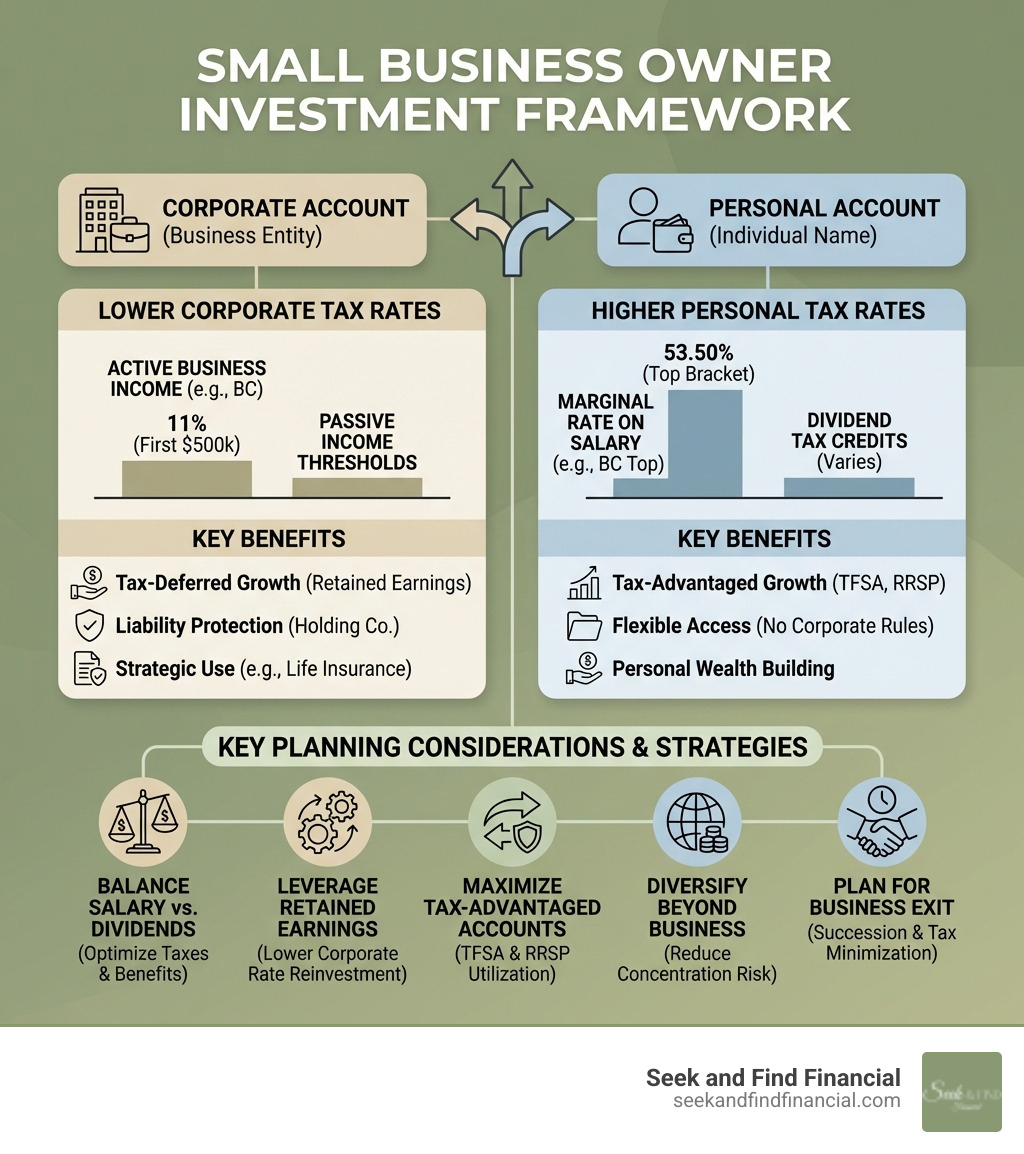

Every dollar your business earns is a choice. Should it stay in the business? Should it go into your pocket? This choice is the core of investment strategies for small business owners. In states like Indiana or Illinois, taxes can take a large part of your pay.
Tax efficiency is very important. By keeping money in the company, you can grow your business faster. You defer personal taxes until you really need the cash. This lets you use more of your money to build wealth.
Should you pay yourself a salary or take a distribution? There is no single answer. It depends on your age and your goals.
Salary is earned income. You must pay Social Security and Medicare taxes on it. It also lets you put money into a 401(k). This is good for building a retirement fund.
Distributions are different. For many small businesses, you do not pay self-employment tax on distributions. This can save you a lot of money. However, distributions do not help you put more into a 401(k).
| Distribution Method | Tax Type | Retirement Room? | Payroll Taxes? |
|---|---|---|---|
| Salary | Personal Income | Yes | Yes |
| Distributions | Personal Income | No | No |
Many owners use both. They take enough salary to fill their retirement accounts. Then they take distributions for extra cash. This keeps their tax bill low while they save for the future.
You should not ignore personal accounts. They are great tools for investment strategies for small business owners.
The Roth IRA is a great choice. For 2025, you can put in $7,000. The money you make inside a Roth IRA is tax-free. You can take it out later and pay no taxes. This is perfect for long term growth.
A SEP IRA or a Solo 401(k) lets you save even more. For 2025, you can put away up to $70,000 or more depending on your income. This lowers your tax bill today. You pay taxes later when you take the money out.
If your business makes more than you need, you have extra earnings. Do not leave this cash in a basic bank account. Inflation will make it worth less over time.
Investing inside a company has rules. In the US, you must watch for the accumulated earnings tax. This happens if you keep too much cash without a clear business plan. You want to invest that money so it works for you.
To manage this, some owners use holding companies. A holding company can own your main business. You can move extra cash there to protect it from risks.
You want your extra cash to grow without high taxes. One way is corporate life insurance. This is not just for safety. The money grows tax-free inside the policy. When you pass away, the money goes to your family tax-free. This is a great way to move money out of the business.
Another way is to focus on long term growth. You only pay taxes on stocks when you sell them. This lets your money grow for a long time without a big tax bill every year.
Do not put all your money in one place. If you own a store, do not just buy retail stocks. If the economy hurts your store, your stocks will go down too. This is a big risk for your wealth.
This is why alternative investments matter. These are things like real estate or private loans. Many owners keep opportunity capital. This is cash ready for a great deal. You might use it to buy a competitor or new tools.
Real estate is a top choice. You can buy the building where you work. You pay rent to yourself. You build value in a real asset. Hold the real estate in a separate company to keep it safe from business lawsuits.
Your business is a high risk asset. To balance that, your personal investments should be steady. Many owners use index funds. These funds track the whole market. They give you many stocks at once and have low fees. This is a simple way to grow your money.
Your timeline is also key. If you retire in 20 years, you can handle market changes. If you sell next year, you must be careful. At Seek & Find Financial, we use tools like Altruist to help you see your goals. We make sure your risk matches your plan.
As you get wealthy, you must protect it. If you are a sole proprietor, you and your business are the same. If the business is sued, your house is at risk. Incorporating creates a shield for your personal assets. This is a vital step for any owner.
You can also use an estate freeze. This locks in the value of your business today. Future growth goes to your children. This can save a lot of tax later. You can also use a family trust. This can help you protect your assets and plan for your heirs.
Most owners sell their business to retire. But a business is only worth what a buyer will pay. You need a plan. This might mean training a new leader or finding a buyer. You should start this plan years before you want to leave.
In the US, look at Section 1202 rules. This is for Qualified Small Business Stock. If you qualify, you might pay zero tax on the first $10 million of gain when you sell. This is a huge tax break. You must plan ahead to make sure you qualify for these savings.
It depends on your retirement goals. Salary helps you put more into a 401(k). Distributions can save you money on payroll taxes. We often suggest using both to get the best results.
If you keep too much cash in your business, the IRS may tax it. We use plans to help your money grow without these extra costs. We look at your whole picture to find the best path.
Yes, for many owners. It lets your cash grow tax-free. It also gives a tax-free payout to your family. It is a great tool for estate planning and tax management.
Building a business is hard. You should not have to work just as hard to keep your money. By using the right investment strategies for small business owners, you can turn your success into wealth for your family.
At Seek & Find Financial, we believe in clear plans. We do not give generic advice. Whether you are in Valparaiso, Crown Point, or Chicago, we help you with tax and wealth plans. This lets you focus on running your company.
The path to a safe retirement needs a plan. You must understand salary, distributions, and tax rules. With a clear strategy, you can build a strong future. We are here to help you every step of the way.
Investing involves risk, including possible loss of principal. No investment strategy can ensure financial success or guarantee against losses. Past performance may not be used to predict future results. Provided content is for overview and informational purposes only, reflect the opinions of the author, and is not intended and should not be relied upon as individualized tax, legal, fiduciary, or investment advice.
This information is being provided only as a general source of information. These views may change as market or other conditions change. This information is not intended and should not be used to provide financial advice and does not address or account for an individual’s circumstances. Past performance does not guarantee future results and no forecast should be considered a guarantee. Please seek the guidance of a financial professional regarding your particular financial concerns.
Investment advisory services offered by duly registered individuals through Seek & find Financial LLC a Registered Investment Adviser. Licensed Insurance Professional