

How to Pick the Best Retirement Savings Plans for Small Business Owners
Discover top retirement savings plans for small business owners: RRSPs, TFSAs, IPPs, DPSPs. Optimize salary vs dividends, LCGE, and succession.

Retirement savings plans for small business owners work differently than employee pensions. You don't have an employer match. You don't have automatic payroll deductions. You're responsible for every dollar you set aside.
Here are the main retirement savings options for small business owners:
The challenge is simple. Most business owners reinvest profits back into operations. They delay personal savings. They plan to fund retirement by selling the business.
But here's the problem. 76% of small business owners plan to leave their business, but only 9% have a formal succession plan. That gap creates risk. What if the business doesn't sell? What if health issues force an early exit?
The numbers get worse. Research shows that 32% of small and mid-sized business owners plan to retire within five years. Only 27% have a formal personal financial plan. That means nearly three-quarters are approaching retirement without a clear strategy.
This isn't about picking one account type. It's about building a system. You need to balance business growth with personal savings. You need to optimize how you pay yourself. You need an exit plan that protects your wealth.
I'm Daniel Delaney, founder of Seek & Find Financial, and I've helped business owners navigate these exact decisions through my work at established advisory firms and now as an independent advisor. Understanding retirement savings plans for small business owners means looking at your business structure, income level, tax situation, and timeline all at once.
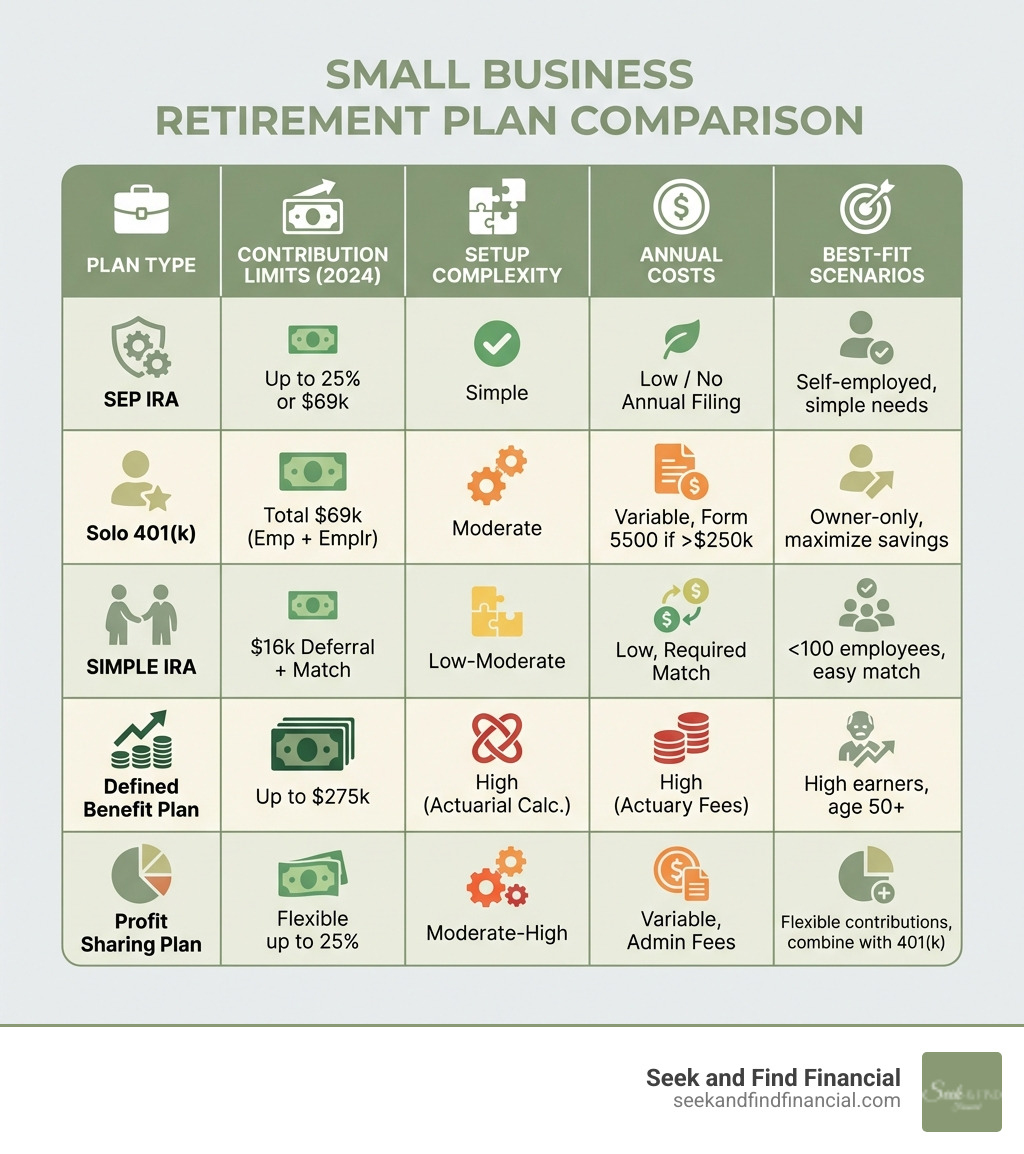

When you run your own shop, you are the boss and the employee. This gives you unique ways to save. Most people know about Traditional and Roth IRAs. But for a business owner, these often aren't enough. The contribution limits are too low to build a real nest egg if you start late.
That is why the IRS created specific retirement savings plans for small business owners. These plans allow you to put away much more money than a standard IRA.
The SEP IRA is a favorite for many. It stands for Simplified Employee Pension. It is very easy to set up. You can contribute up to 25% of your compensation. For 2024, the limit is $69,000. It is great because you don't have to contribute every year. If business is slow, you can skip it. If you have a great year, you can max it out.
The Solo 401(k) is another powerhouse. It is for business owners with no employees other than a spouse. It lets you contribute as both the employer and the employee. This often allows you to hit the maximum limit even with a lower salary.
You should also look at your Traditional IRA and Roth IRA options. While the limits are lower, they are still important parts of a diversified plan. You can check your contribution room and tax filings through official government portals to see where you stand with previous years.
If you are a high earner, a standard 401(k) might still feel small. This is where an Individual Pension Plan (IPP) or a Defined Benefit Plan comes in. These are often best for business owners over age 40 who earn a high income.
An IPP is essentially a private pension plan for you. The company makes the contributions. Because it is a "defined benefit" plan, the goal is to provide a specific income in retirement. This means you can often contribute much more than $69,000 a year.
One of the biggest perks of an IPP is creditor protection. In many cases, the money in these plans is safe if the business faces legal trouble. Plus, the contributions are a tax deduction for your corporation. This lowers your current tax bill while building your future wealth.
Do you have employees? If so, your retirement plan can be a tool to keep your best people. A SIMPLE IRA is a great middle ground. It is less complex than a full 401(k) but offers more than a basic IRA.
You can also look into Profit Sharing Plans. These allow you to give employees a slice of the pie when the business does well. It is flexible. You decide each year how much to contribute.
Offering these plans helps with employee retention. It shows your team you care about their future. At Seek & Find Financial, we help owners design these systems to benefit both the owner and the staff. You can find more info about our services on our website to see how we integrate team benefits into your personal wealth strategy.
How you take money out of your business changes your retirement. In the US, this usually comes down to how you structure your salary versus business draws or dividends.
If you pay yourself a high salary, you pay more in payroll taxes (Social Security and Medicare). But, a higher salary also allows for higher 401(k) or SEP IRA contributions. It also increases your future Social Security benefits.
If you take more in dividends or owner draws, you might save on some taxes now. But you aren't building up that "earned income" needed for many retirement accounts.
| Feature | Salary | Dividends/Draws |
|---|---|---|
| Payroll Taxes | Yes | No (usually) |
| Retirement Room | High | Low/None |
| Social Security | Increases Benefit | No Impact |
| Current Tax | Higher | Often Lower |
Choosing the right mix is a balancing act. We look at your total tax picture to find the "sweet spot." You can check your projected government benefits at My Service Canada Account or the Social Security Administration website to see how your current pay affects your future check.
Many owners think, "My business is my retirement." They plan to sell it and live off the profit. This can work, but you have to be careful with taxes.
When you sell a business, you might owe capital gains tax. This can take a huge bite out of your retirement fund. However, there are ways to reduce this. In some regions, there are specific exemptions for small business shares.
For example, the Lifetime Capital Gains Exemption (LCGE) is a major tax break. As of 2024, this can exempt a large portion of your gain from taxes if your business meets certain rules.
To qualify, your business must be an active small business. You can't just have a pile of cash sitting in the company bank account. This is called "asset purification." You need to clean up the business assets years before you sell. If you wait until the last minute, you might miss out on saving hundreds of thousands of dollars in taxes.
A succession plan is a map for how you leave. Who takes over? Do you sell to a partner? Do you pass it to your kids? Or do you sell to an outside buyer?
As we mentioned, 76% of owners want to exit, but almost no one has a plan. Without a plan, you might be forced to sell for less than the business is worth. Or worse, the business might fail when you leave.
A good plan includes:
Succession planning protects your legacy. It ensures that the years of hard work you put in actually turn into a stable retirement.
Most experts say you need 70% to 90% of your pre-retirement income. If you spend $10,000 a month now, you might need $8,000 a month in retirement. A common rule is to multiply your yearly expenses by 25. If you need $100,000 a year, you need a $2.5 million nest egg.
The best time was yesterday. The second best time is today. Ideally, you should start formal succession planning at least five to ten years before you want to leave. This gives you time to "purify" assets for tax breaks and train your replacement.
Inflation makes things more expensive over time. If inflation is 3%, the price of everything doubles in about 24 years. Your retirement plan must account for this. You can't just save cash; your money needs to grow faster than the cost of living.
At Seek & Find Financial, we know that retirement savings plans for small business owners are not one-size-fits-all. You have worked hard to build your business in places like Crown Point, Valparaiso, and Chicago. You deserve a retirement that reflects that effort.
We use a personalized, technology-driven approach. By using tools like Altruist, we can build a structured plan that grows with you. We don't just give generic advice. We look at your taxes, your business structure, and your real-life goals.
Don't leave your future to chance. Whether you are looking at a Solo 401(k), an IPP, or a complex business sale, we are here to help you find the right path. Visit our website to start building your clear financial direction today.
Investing involves risk, including possible loss of principal. No investment strategy can ensure financial success or guarantee against losses. Past performance may not be used to predict future results. Provided content is for overview and informational purposes only, reflect the opinions of the author, and is not intended and should not be relied upon as individualized tax, legal, fiduciary, or investment advice.
This information is being provided only as a general source of information. These views may change as market or other conditions change. This information is not intended and should not be used to provide financial advice and does not address or account for an individual’s circumstances. Past performance does not guarantee future results and no forecast should be considered a guarantee. Please seek the guidance of a financial professional regarding your particular financial concerns.
Investment advisory services offered by duly registered individuals through Seek & find Financial LLC a Registered Investment Adviser. Licensed Insurance Professional