

The Art of Financial Strategy: Maximizing ROI Through Strategic Decisions
Master strategic financial decisions to maximize ROI. Learn goal-setting, capital allocation, cash flow analysis & long-term growth tactics.

Strategic financial decisions are the critical choices that shape your company's long-term financial health and determine whether your wealth grows or stagnates. These are not the day-to-day budget adjustments or monthly cash flow tweaks. They are the major decisions about capital allocation, business expansion, debt structure, tax strategy, and how you position your assets for sustainable growth over years and decades.
What Strategic Financial Decisions Include:
The research is clear. Companies that invest strategically outperform their peers by significant margins. Top performers invested approximately 50% more in capital expenditures than their competitors and achieved roughly 55% higher returns on assets and 65% higher sales growth. Yet many business owners struggle with these decisions because they lack a clear framework or get caught up in short-term pressures at the expense of long-term value.
Strategic financial management differs sharply from tactical management. Tactical decisions address immediate needs like adjusting this quarter's budget or managing a temporary cash crunch. Strategic decisions focus on the bigger picture: how to position your business and personal wealth for sustained success over the next 5, 10, or 20 years. This means sometimes accepting short-term costs or restructuring to create long-term efficiency and growth.
The stakes are high. Research shows that 34% of Americans have no savings, and capex levels relative to revenues have fallen by 10% in the last decade while cash hoarding and shareholder payouts have risen by over one third. This trend reflects uncertainty and short-term thinking, but it also creates opportunity for business owners who think strategically and act with discipline.
As Daniel Delaney, Founder of Seek & Find Financial, I've worked with business owners and families to build clear, structured strategies around strategic financial decisions that align resources with long-term goals. My experience at established financial institutions and now as an independent advisor has shown me that the most successful clients don't chase short-term wins but instead build flexible, disciplined frameworks for capital allocation, risk management, and wealth growth.
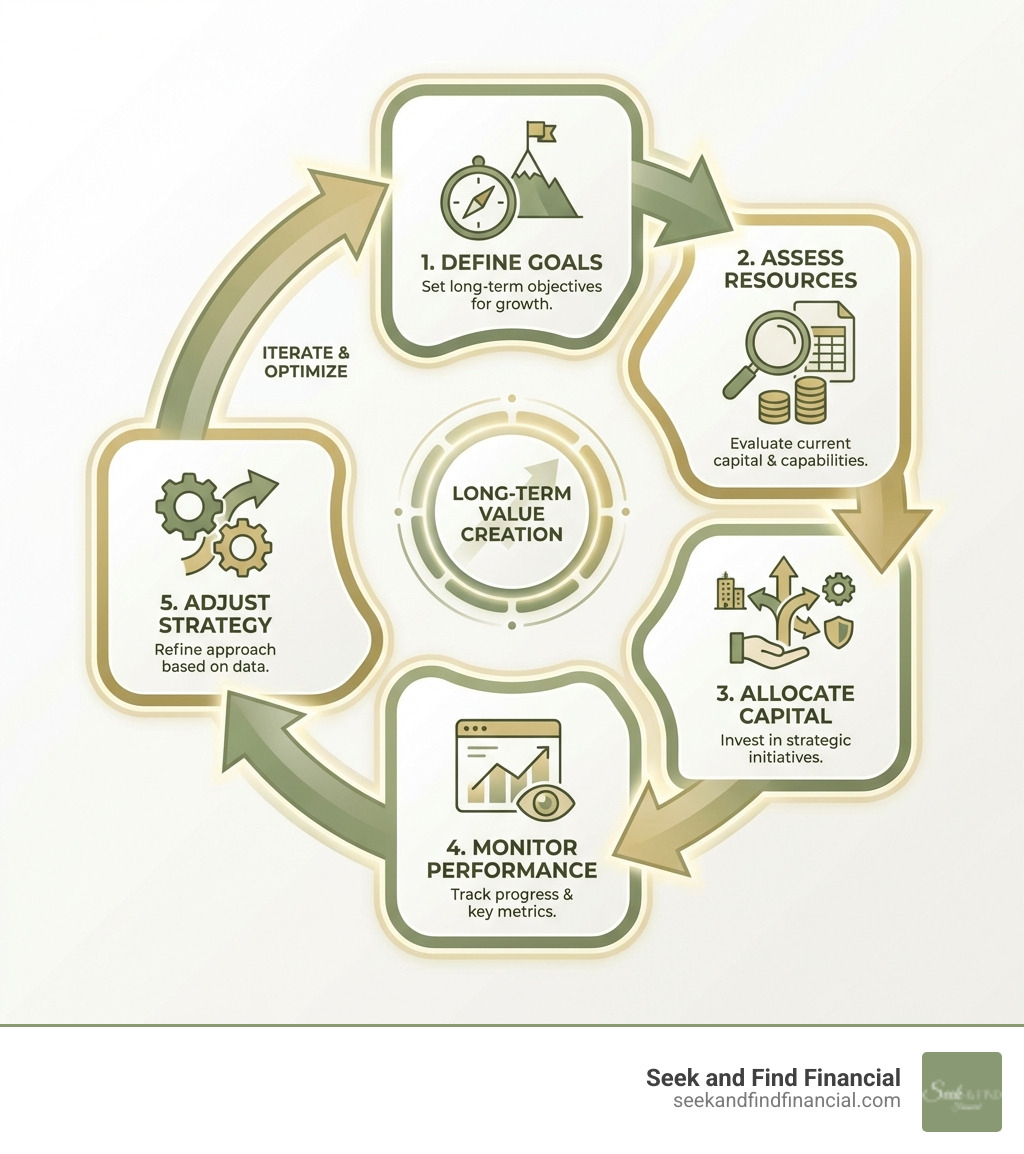
To understand strategic financial decisions, we first need to look at what they are not. They are not the small, daily tasks of an accountant. While tactical management keeps the lights on today, strategic management ensures the lights stay on for the next twenty years.
If you are a business owner in Valparaiso or Chicago, you might face a choice. Do you keep all your extra cash in a low-interest savings account, or do you invest it in a new product line? The first choice is safe but slow. The second choice is a strategic decision that could double your company size.
Strategic management focuses on maximizing shareholder wealth. For an entrepreneur, that shareholder is often you and your family. We use tools and resources like those found at CFI Corporate Finance Resources to help define these paths.
The goal is sustainable growth. This means growing in a way that does not break the company. We want to see profit, yes, but we also want to see value. A company that makes a million dollars today but has no plan for tomorrow is not as valuable as a company that makes less now but has a solid foundation for the future.

A good financial strategy is like a well-built house. It needs a strong foundation. For us, that foundation has four parts:
We often help our clients in Merrillville and Crown Point choose between different ways to set goals. The table below shows the two most common frameworks.
FeatureSMART GoalsFAST GoalsFocusRealistic and AttainableAmbitious and High-GrowthTrackingMeasured at the endFrequent check-insVisibilityOften private to leadersTransparent across the teamBest ForStable, steady growthFast-moving companies
Setting goals is the heart of the process. Traditional SMART goals (Specific, Measurable, Attainable, Realistic, Time-bound) are great for many. But many modern firms prefer the FAST framework. FAST stands for Frequent, Ambitious, Specific, and Transparent.
When we set goals, we must align them with the whole business. If your marketing team wants to spend big but your finance team wants to save, you have a problem. We bring these departments together. We use Key Performance Indicators (KPIs) to track progress. This ensures every dollar spent is moving you toward your big objective.
Capital allocation is just a fancy way of saying "deciding where the money goes." It is one of the most important jobs of a leader. According to The Art of Capital Allocation by BCG, the best companies invest in whole businesses, not just tiny projects.
We use several technical tools to make these choices:
At Seek & Find Financial, we use modern tools like Altruist to give our clients in Chesterton and Portage a clear view of their wealth. Automation is a big help here. It reduces human error and gives us real-time data. Instead of waiting for a monthly report, we can see how strategic financial decisions are performing right now.
Most people look at a Profit and Loss statement and only see the bottom line. But profit can be a bit of an "opinion." Accounting rules allow for many different ways to show profit. Cash, however, is a "fact." You either have it or you don't.
To find the truth, we look deeper. We use the Strategy Engine framework to read between the lines. We look at things like:
Cash flow is the lifeblood of any business in Hobart or Hebron. One key metric we track is the Cash Conversion Cycle (CCC). This is the time it takes to turn a dollar spent on supplies back into a dollar of cash from a sale.
A great example is the retail firm DMart. They operate with a CCC of just 23 days. Because they move inventory so fast and get paid quickly, they need very little extra cash to run a huge business. This efficiency allows them to reinvest in new stores without taking on massive debt.
Managing your debt and reinvestment strategy is part of this cycle. We help you decide if you should pay off a loan or use that cash to buy a new piece of equipment. We also look at your sustainable spend rate. This is the amount of money you can take out of your business or investments without hurting your long-term growth.
Making these decisions is not always easy. Human nature often gets in the way. We call these "cognitive biases." For example, "anchoring" is when we stick to the first piece of information we hear, even if it is wrong. "Short-termism" is the urge to make a quick buck today even if it hurts us tomorrow.
Market volatility is another challenge. The economy in the Chicago area and Northwest Indiana changes constantly. To navigate this, we use a "pre-mortem" analysis. We imagine a project has failed and work backward to see why. This helps us find hidden risks before they happen.
Resistance to change is also common. Teams might be used to doing things the old way. We overcome this by being transparent and showing the data. When everyone sees the long-term benefit, they are more likely to get on board.
Strategic decisions are about the long-term "where" and "why." They involve things like entering a new market, changing your company's debt structure, or long-term tax planning. Tactical decisions are about the "how" of today. They include things like managing this week's payroll, paying bills, or adjusting a monthly marketing spend.
Automation tools, like the ones we use at Seek & Find Financial, take over the boring, manual work of data entry. This reduces mistakes. More importantly, it gives us real-time insights. Instead of looking at what happened last month, we can see what is happening today. This allows us to make faster, smarter strategic financial decisions.
The art of financial strategy is about more than just numbers. It is about having a clear direction and the discipline to follow it. By focusing on long-term goals rather than short-term distractions, you can build a business and a life that is stable and successful.
Whether you are an entrepreneur in Valparaiso or a business owner in Chicago, structured planning is the key. We believe in personalized, technology-driven strategies that fit your real life. Don't settle for generic advice when your future is on the line.
If you want to learn more about how we can help you navigate these choices, visit us to see more info about our financial services. Together, we can build a strategy that maximizes your returns and secures your legacy.
Investing involves risk, including possible loss of principal. No investment strategy can ensure financial success or guarantee against losses. Past performance may not be used to predict future results. Provided content is for overview and informational purposes only, reflect the opinions of the author, and is not intended and should not be relied upon as individualized tax, legal, fiduciary, or investment advice.
This information is being provided only as a general source of information. These views may change as market or other conditions change. This information is not intended and should not be used to provide financial advice and does not address or account for an individual’s circumstances. Past performance does not guarantee future results and no forecast should be considered a guarantee. Please seek the guidance of a financial professional regarding your particular financial concerns.
Investment advisory services offered by duly registered individuals through Seek & find Financial LLC a Registered Investment Adviser. Licensed Insurance Professional