

Stop Giving Away Your Profits with Tax Effective Investing
Master tax effective investing to slash taxes, boost after-tax returns, and grow your wealth with proven strategies.
Tax effective investing is a legal strategy to minimize tax drag on your portfolio and maximize your after-tax returns through smart account selection, strategic asset placement, and thoughtful timing of transactions. Here's what you need to know:
Key Components of Tax Effective Investing:
Of all the expenses you'll pay as an investor, taxes have the potential to take the biggest bite out of your total returns. While you can't control market performance, you can control how much of your investment gains you keep versus what you hand over to the IRS each year.
Most high-earning business owners and entrepreneurs focus heavily on reducing taxes within their business operations. That's smart. But many overlook the silent drain happening inside their investment portfolios. Over 30 years, the difference between tax-efficient and tax-inefficient investing can cost you hundreds of thousands of dollars in wealth that could have been yours.
The math is straightforward. A stock fund generating 8% annual returns might cost you just 0.37% per year in taxes if managed efficiently. A high-turnover active fund or bond portfolio could cost 1.32% or more annually. Compounded over decades, that difference is massive.
I'm Daniel Delaney, founder of Seek & Find Financial, and throughout my career working within established financial institutions and now leading an independent advisory firm, I've seen how tax effective investing strategies can dramatically accelerate wealth building for business owners and families. The strategies aren't complicated, but they do require structure, discipline, and a clear understanding of how different accounts and investments are taxed.
When we talk about building wealth, most people focus on the "top line" number. They want to see their portfolio grow by 7 or 10 percent each year. But for entrepreneurs in places like Valparaiso or Crown Point who are earning $400,000 or more, the "bottom line" is what actually pays for your lifestyle. The bottom line is your after-tax return.
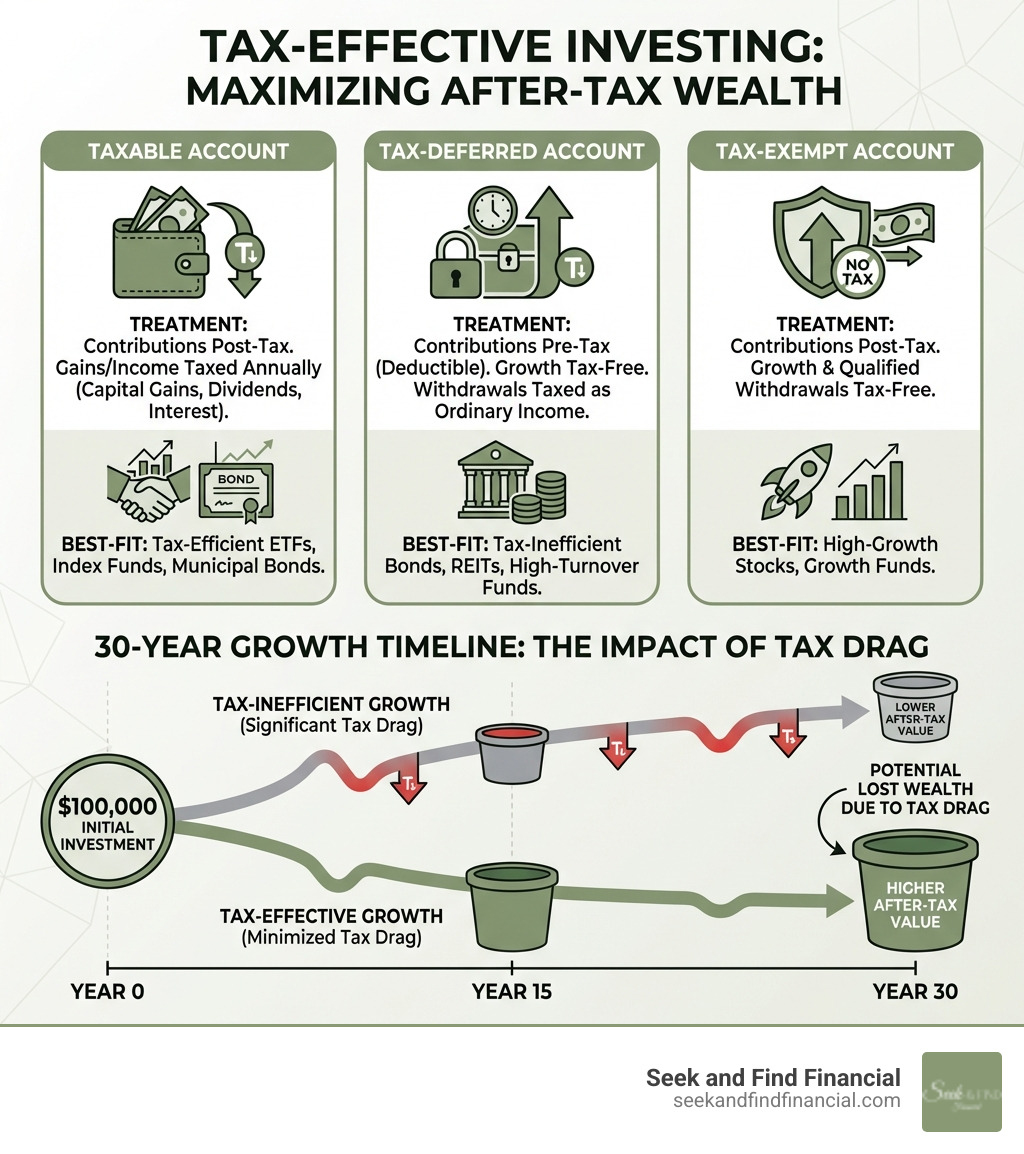
Taxes are often the single largest expense an investor faces. They can be much larger than management fees or trading costs. We call this "tax drag." Think of tax drag like a heavy weight tied to your ankles while you try to run a race. It slows you down every single year.
Research shows that over a 30 year period, a tax-efficient stock portfolio might lose only 0.37% of its value to taxes each year. On the other hand, a tax-inefficient portfolio could lose 0.66% or more. That might seem like a small gap. However, over decades, that small gap can grow into a massive hole in your retirement fund.
At Seek & Find Financial, we believe that tax effective investing is not just a buzzword. It is a foundation for your financial plan. We cannot control what the stock market does tomorrow. We cannot control what happens in Chicago or the global economy. But we can control how we plan for taxes. By being smart about where we hold our assets and when we sell them, we help you keep more of what you earn.

To understand tax effective investing, you first need to understand the three "buckets" where you can put your money. Each bucket has different rules. Using the right bucket for the right investment is the first step to saving money.
| Account Type | Tax Treatment | Best For |
|---|---|---|
| Taxable (Brokerage) | Pay taxes on dividends and gains each year | ETFs, Index Funds, Municipal Bonds |
| Tax-Deferred (401k/IRA) | Pay no tax now, pay ordinary income tax later | Bonds, REITs, High-turnover funds |
| Tax-Exempt (Roth) | Pay tax now, pay zero tax later | High-growth stocks, Aggressive funds |
A taxable account is a standard brokerage account. You fund it with money that has already been taxed. The big benefit here is flexibility. You can take your money out whenever you want. There are no 10 percent penalties for early withdrawal like you find in retirement accounts.
In these accounts, you pay taxes on dividends and interest every year. You also pay capital gains taxes when you sell an investment for a profit. However, these accounts allow for a strategy called tax-loss harvesting. This lets us use investment losses to lower your tax bill. For high earners in Merrillville or Hobart, this flexibility is a key part of a wealth strategy.
Tax-deferred accounts like a Traditional 401k or IRA give you a tax break today. You put "pre-tax" money in, which lowers your current taxable income. The money grows without the IRS taking a cut every year. You only pay taxes when you take the money out in retirement. This is great if you think your tax rate will be lower in the future.
Tax-exempt accounts, like a Roth IRA or Roth 401k, are the "what you see is what you get" accounts. You do not get a tax break today. But once the money is in the account, it grows tax-free. When you take it out in retirement, you pay zero taxes. For our clients in Indiana and Illinois who expect to be in a high tax bracket for a long time, Roth accounts can be a game changer.
Think of tax effective investing like a game of chess. You have to think several moves ahead. You do not want to just buy a stock because it looks good. You want to think about where that stock should live and how long you plan to hold it.
One of the most powerful tools we use is tax-loss harvesting. If an investment goes down in value, we can sell it to "realize" a loss. We can then use that loss to offset any gains you made elsewhere. If your losses are more than your gains, you can use up to $3,000 of those losses to reduce your regular taxable income. Any extra losses can be carried forward to future years.
There is a catch called the wash-sale rule. You cannot sell a stock for a loss and then buy the same stock back right away. You must wait at least 30 days before or after the sale. If you don't wait, the IRS will not let you claim the loss. We help our clients navigate these rules to make sure their losses are actually useful.
Asset location is different from asset allocation. Asset allocation is deciding how much you want in stocks versus bonds. Asset location is deciding which account holds those stocks or bonds.
A general rule of thumb is to put tax-inefficient assets into tax-advantaged accounts. For example, bonds pay interest that is taxed at high ordinary income rates. It often makes sense to put bond funds in a 401k or IRA. On the other hand, stocks often generate qualified dividends and long-term capital gains, which are taxed at lower rates. These often belong in your taxable brokerage account.
Real Estate Investment Trusts (REITs) are very tax-inefficient. They must give away almost all their income to shareholders, and that income is usually taxed at high rates. We almost always prefer to see REITs inside a retirement account.
When we build a portfolio at Seek & Find Financial, we look at the internal "turnover" of a fund. Turnover is how often the fund manager buys and sells stocks. Every time they sell a stock for a profit, it creates a tax bill for you.
Passive funds, like index funds and ETFs, are generally more tax-efficient than active funds. This is because they do not trade very often. ETFs have a special technical advantage in how they settle trades that helps them avoid triggering capital gains.
For our high-earning clients in Portage or Hebron, municipal bonds are another great tool. The interest from these bonds is usually exempt from federal taxes. If you live in the state that issued the bond, it might be exempt from state and local taxes too. Treasury bonds and Series I bonds are also helpful because their interest is exempt from state and local taxes.
While taxes are important, you should never let the "tax tail wag the investment dog." This means you should not make a bad investment just because it saves you on taxes. If you refuse to sell a stock because you don't want to pay capital gains tax, you might end up with a portfolio that is not diversified.
If one stock grows to be 50 percent of your wealth, you are taking a huge risk. We work with our clients to balance the need for tax efficiency with the need for a safe, diversified portfolio. Our use of technology like Altruist helps us monitor these levels in real-time.
Tax effective investing is a legal and smart way to follow the tax code to your advantage. It involves using the rules the government created (like 401ks and Roth IRAs) to keep more of your money. Tax avoidance or tax evasion involves illegal tactics to hide money or lie to the IRS. We only use legal, proven strategies to help you grow your wealth.
The timing of your sales matters a lot. If you hold an investment for one year or less, your profit is a "short-term gain." This is taxed at your ordinary income rate, which can be as high as 40.8% for high earners.
If you hold the investment for more than one year, it becomes a "long-term gain." These are taxed at much lower rates: 0%, 15%, or 20% depending on your income. You can find more details on these rates at the IRS website. By waiting just one extra day to sell, you could cut your tax bill in half.
You should review your tax forms every year, specifically your 1099-DIV and 1099-B. Look for "capital gain distributions." If your mutual funds are sending you large tax bills even when you didn't sell anything, your portfolio might be inefficient. We provide our clients with clear reporting so they can see exactly how much they are keeping after taxes.
Building wealth as a business owner in Northwest Indiana or Chicago requires more than just picking good stocks. It requires a system. At Seek & Find Financial, we provide that system through personalized, technology-driven planning. We don't give generic advice because your life isn't generic.
Whether you are in Valparaiso, Chesterton, or Chicago, we are here to help you stop giving away your profits. By using tax effective investing, we help you turn your hard work into long-term financial freedom. It is about more than just numbers on a screen. It is about making sure you have the resources to live your ideal life.
Investing involves risk, including possible loss of principal. No investment strategy can ensure financial success or guarantee against losses. Past performance may not be used to predict future results. Provided content is for overview and informational purposes only, reflect the opinions of the author, and is not intended and should not be relied upon as individualized tax, legal, fiduciary, or investment advice.
This information is being provided only as a general source of information. These views may change as market or other conditions change. This information is not intended and should not be used to provide financial advice and does not address or account for an individual’s circumstances. Past performance does not guarantee future results and no forecast should be considered a guarantee. Please seek the guidance of a financial professional regarding your particular financial concerns.
Investment advisory services offered by duly registered individuals through Seek & find Financial LLC a Registered Investment Adviser. Licensed Insurance Professional