

Beyond Deductions: Maximizing Your Money with Tax-Efficient Wealth Management
Master tax efficient wealth management: Minimize drag, optimize asset location, harvest losses, and boost long-term returns.
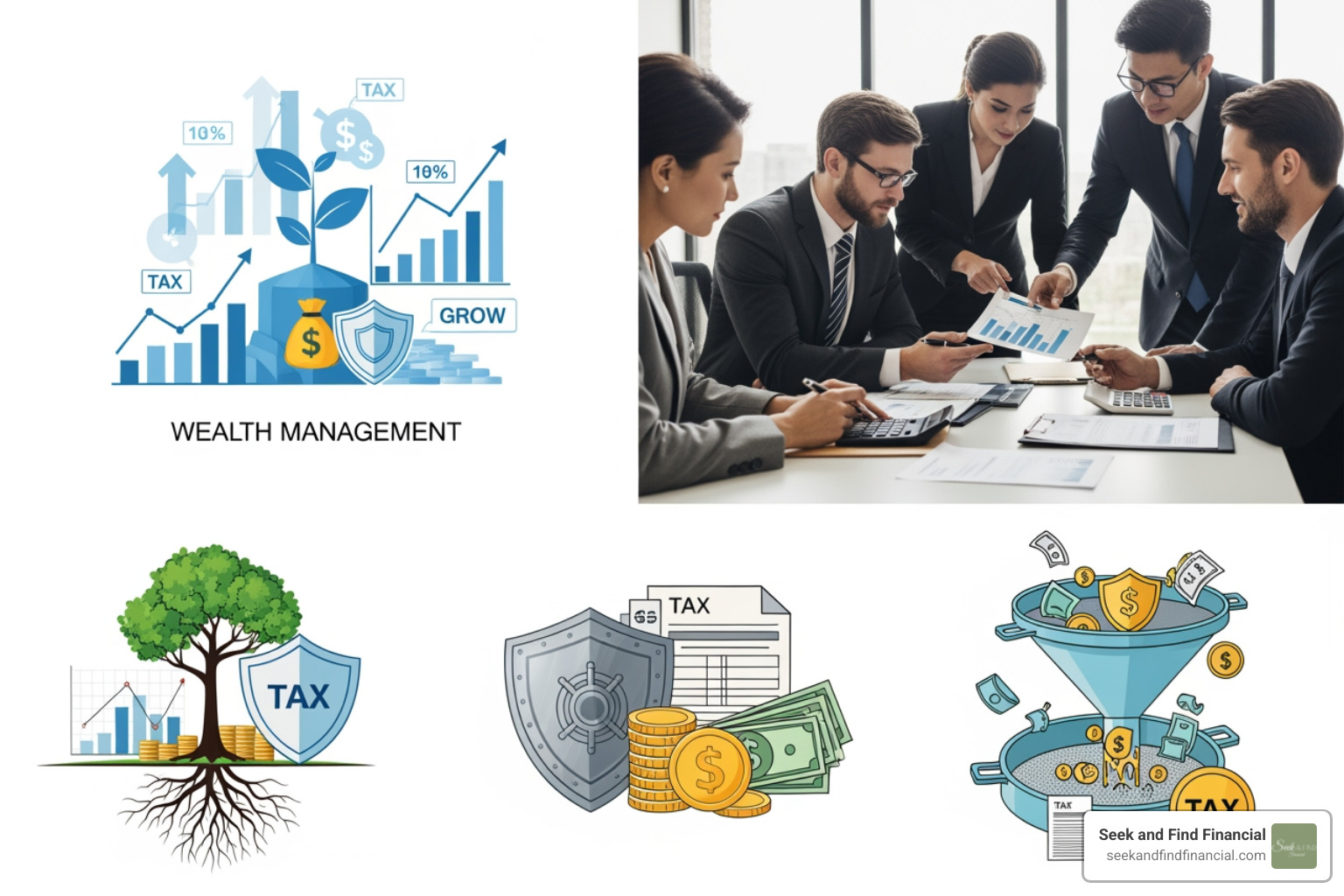
Tax efficient wealth management is a strategy that helps you keep more of what you earn. It reduces the tax burden on your investment returns. Here is what you need to know:
Most investors focus on investment fees. They compare expense ratios and management costs. But taxes often take a much bigger bite out of returns.
In fact, taxes can represent more than 50% of gross investment returns in some cases. For a high earner in a high-tax state earning 10% annually in short-term returns, you might keep only 41 cents of every dollar earned after 10 years.
That is not a small problem. It is a wealth destroyer that compounds over decades.
The good news? Unlike market performance, taxes are something you can actively manage. Small improvements in tax efficiency, even just 0.5% per year, can result in 50% more wealth after 30 years of distributions.
But tax-efficient wealth management requires more than just picking the right funds. It means thinking strategically about account types. It means thinking about withdrawal timing and asset location. Every financial decision impacts your tax bill.
I am Daniel Delaney. I am the founder of Seek & Find Financial. I have spent my career helping clients build long-term wealth strategies. These strategies focus on tax efficiency at every stage. As an independent advisor, I have seen how tax efficient wealth management transforms what clients keep and grow over time.
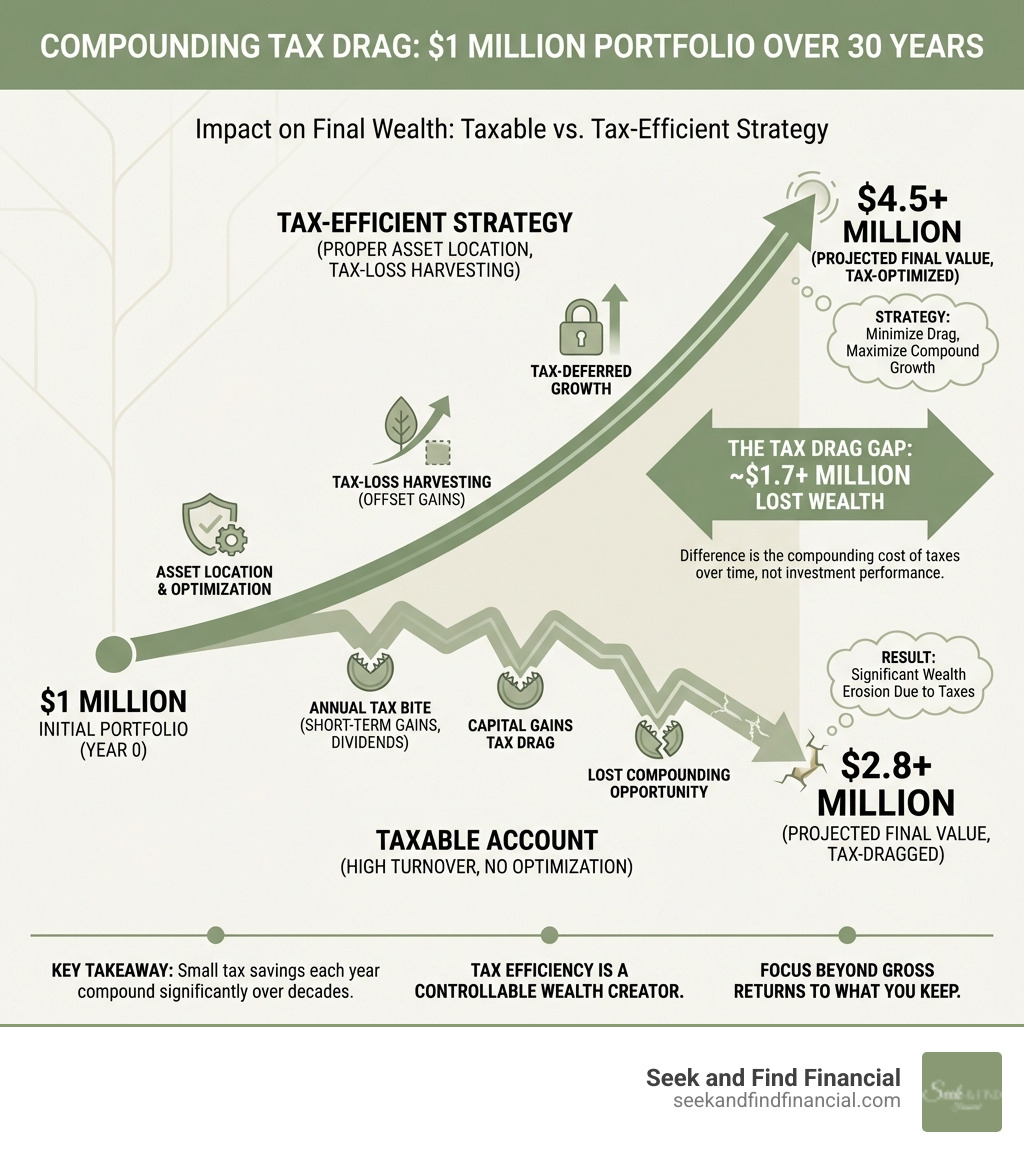
When we talk about investing, we often talk about "gross returns." This is the headline number you see on a statement. But you cannot spend gross returns. You can only spend what is left after the government takes its share. We call this "tax drag."
Tax drag is often a much bigger expense than investment fees. While a fund fee might be 0.10% or 0.75%, taxes can easily slash your returns by 2% or more every year. For a high-net-worth investor in the 39.6% federal bracket, the return on a corporate bond can drop from a 5.5% pre-tax yield to just 3.3% after-tax.
Portfolio turnover is a silent killer here. Many active fund managers trade stocks frequently. Every time they sell a stock for a profit, they create a tax bill for you, even if you didn't sell your shares in the fund. Some managers turn over 100% of their portfolio every year. This passes a massive tax bill to you, the investor.
By focusing on tax efficient wealth management, we aim to reduce this drag. Think of it like fixing a leak in a bucket. You can keep pouring more water (higher risk investments) into the bucket, but it is much easier to just plug the hole.

To build a tax-efficient plan, we look at how different types of income are taxed. Not all dollars are created equal in the eyes of the IRS.
The holding period is everything. Selling an asset at 364 days versus 366 days could mean the difference between paying 37% in tax or 20%.
| Gain Type | Holding Period | Tax Rate (Federal) |
|---|---|---|
| Short-Term Capital Gain | 1 Year or Less | Ordinary Income Rates (up to 37%+) |
| Long-Term Capital Gain | More than 1 Year | 0%, 15%, or 20% (based on income) |
Most people know about asset allocation (how much you put in stocks vs. bonds). But asset location is just as important. This is the practice of putting the right investments into the right types of accounts.
We generally work with three types of accounts:
A smart tax efficient wealth management strategy places "tax-ugly" investments (like high-yield bonds or high-turnover funds) inside tax-deferred accounts. We keep "tax-friendly" investments (like index funds or municipal bonds) in taxable accounts. This simple move can improve your after-tax returns by 0.34% or more annually.
In a taxable account, you have a lot of control. You only pay capital gains tax when you sell. This means you can choose when to "realize" a gain.
We look at your "cost basis" and specific "tax lots." If you bought a stock at different times and prices, we can choose to sell the specific shares that have the smallest gain or even a loss. This is much better than just selling "average" shares.
Sometimes, it actually makes sense to realize long-term gains on purpose. If you are in a lower tax bracket one year, we might sell an asset to "lock in" the 0% or 15% rate and then immediately buy it back. This resets your cost basis higher for the future.
One of the most powerful tools we use is tax-loss harvesting. This is the process of selling an investment that has lost value to capture that loss. You can use that loss to offset any capital gains you have. If your losses are more than your gains, you can use up to $3,000 of the extra loss to offset your regular salary income.
There is a rule called the wash sale rule. You cannot sell a stock for a loss and buy the same stock within 30 days before or after the sale. If you do, the IRS ignores the loss. We help clients navigate this. We buy a similar but not identical investment. This lets you stay in the market while keeping the tax benefit.
For high earners in places like Crown Point or Chesterton, Indiana, municipal bonds are a great tool. The interest from these bonds is usually free from federal income tax. If you live in Indiana and buy Indiana municipal bonds, they are often state-tax-free too. For someone in the top tax bracket, a 3% tax-free yield might be better than a 5% taxable yield from a regular corporate bond.
How you take money out in retirement is just as important as how you put it in. Many people just take money from their taxable account first because it's easy. But that might not be the best way.
An optimal withdrawal sequence usually involves a mix of accounts to keep you in the lowest possible tax bracket. We might take some money from a taxable account, some from a Traditional IRA, and some from a Roth IRA.
We also look at Roth conversions. This is when you move money from a Traditional IRA to a Roth IRA and pay the tax now. Why would you do this? If we think your tax rate will be higher in the future (perhaps because of Required Minimum Distributions or tax law changes), it is better to pay the "tax on the seed" now rather than the "tax on the harvest" later.
For those who are charitable, using a Donor-Advised Fund (DAF) can be a game-changer. You can "bunch" several years of donations into one year to get a big tax deduction, then give the money to your favorite charities over time. This is especially helpful if you are close to the limit where itemizing your deductions makes sense.
The wash sale rule prevents you from claiming a tax loss if you buy the same or a "substantially identical" security within 30 days of selling it at a loss. This includes 30 days before the sale and 30 days after. The goal is to prevent people from "faking" a loss just for tax purposes while essentially keeping the same investment.
Even though an IRA is tax-deferred, you can still face "hidden" costs. If you hold active mutual funds inside an IRA, the fund manager may trade frequently. While you don't pay taxes on those trades today, the internal tax costs and turnover can create a drag on the fund's performance. Furthermore, every dollar that comes out of a Traditional IRA is taxed as ordinary income, which can be much higher than capital gains rates.
Municipal bonds are useful because their interest is generally exempt from federal income taxes. For investors in the 35% or 37% tax bracket, the "tax-equivalent yield" of a municipal bond is often higher than what they could get from a taxable bond of similar risk. It is a way to earn income without increasing your tax bill.
At Seek & Find Financial, we believe that tax efficient wealth management is not just an "add-on" service. It is the foundation of a smart wealth strategy. Whether you are a business owner in Merrillville, Indiana, or a professional in Chicago, Illinois, the goal is the same: grow your wealth while keeping the government's share as low as legally possible.
Small changes in how you locate assets, how you harvest losses, and how you sequence your withdrawals can lead to hundreds of thousands of dollars in extra wealth over your lifetime. It is about having a clear, personalized strategy that uses technology like Altruist to monitor your tax opportunities in real-time.
If you are ready to move beyond generic advice and start a plan that prioritizes what you actually keep, we are here to help. We serve clients across Northwest Indiana and the Chicago area, including Portage, Hebron, and Hobart.
Investing involves risk, including possible loss of principal. No investment strategy can ensure financial success or guarantee against losses. Past performance may not be used to predict future results. Provided content is for overview and informational purposes only, reflect the opinions of the author, and is not intended and should not be relied upon as individualized tax, legal, fiduciary, or investment advice.
This information is being provided only as a general source of information. These views may change as market or other conditions change. This information is not intended and should not be used to provide financial advice and does not address or account for an individual’s circumstances. Past performance does not guarantee future results and no forecast should be considered a guarantee. Please seek the guidance of a financial professional regarding your particular financial concerns.
Investment advisory services offered by duly registered individuals through Seek & find Financial LLC a Registered Investment Adviser. Licensed Insurance Professional