

Tax Reduction Strategies 101
Discover tax reduction strategies for retirement, HSAs, business expenses, deductions & credits. Maximize savings & grow wealth in 2025!

Tax reduction strategies are legal methods to lower your taxable income and reduce the amount you pay to the IRS each year. For high-earning business owners and entrepreneurs making $400,000 or more annually, the higher your tax bracket, the more complicated and costly tax planning becomes. Without a structured approach, you could be overpaying by tens of thousands of dollars every year.
The most effective tax reduction strategies include:
The key insight is this: tax planning is not about finding loopholes. It's about understanding the tax code and making informed decisions throughout the year, not just at filing time. Effective tax reduction requires a proactive mindset that starts at the beginning of each year and revisits strategies at year-end to identify final opportunities.
Many high-income earners leave money on the table because they rely on generic advice that doesn't account for their complex financial situation. The difference between paying what you legally owe and overpaying can easily exceed $50,000 to $100,000 annually when you factor in federal, state, and self-employment taxes.
I'm Daniel Delaney, founder of Seek & Find Financial, and I've spent my career helping individuals and families navigate complex financial decisions, including implementing tax reduction strategies that align with their long-term wealth goals. In this guide, I'll walk you through practical, actionable strategies that can significantly lower your tax bill while building sustainable wealth.
Planning for the future is one of the best ways to lower your taxes today. When we talk about retirement accounts, we are really talking about using pretax dollars to build wealth. This means the money goes into your account before the government takes its share.
For 2025, the 401(k) contribution limit is $23,500 for those under 50. If you are 50 or older, you can add a catch-up contribution of $7,500, bringing your total to $31,500. There is even a special rule for those aged 60 through 63 in 2025, allowing a higher limit of $34,750. By maximizing these contributions, you reduce your taxable income dollar-for-dollar. For a high earner in the 37% bracket, putting $31,500 into a 401(k) could save over $11,000 in federal taxes alone.
Traditional IRAs also offer tax benefits, though deductibility depends on your income and whether you have a retirement plan at work. The IRA limit for 2025 is $7,000, or $8,000 if you are 50 or older. You can find more info on retirement account limits to see how these numbers have shifted from previous years.
We often tell our clients that a Health Savings Account (HSA) is the most powerful tax tool available. It offers a "triple tax benefit" that no other account can match. First, your contributions are pretax, which lowers your income now. Second, the money grows tax-deferred. Third, withdrawals are tax-free if used for qualified medical expenses.
In 2025, the contribution limit for a Health Flexible Spending Account (FSA) is $3,300. While an FSA is helpful, it usually has a "use-it-or-lose-it" rule. An HSA, however, stays with you forever. If you don't spend it on healthcare today, it can act as a second retirement account later in life. To use an HSA, you must have a high-deductible health plan.
How you invest is just as important as how much you invest. If you buy a stock and sell it in less than a year, any profit is taxed at your ordinary income rate, which could be as high as 37%. But if you hold that asset for more than a year, it qualifies for long-term capital gains rates of 0%, 15%, or 20%.
In 2025, if your taxable income is $48,350 or less (for single filers), your long-term capital gains tax rate is actually 0%. For most high earners in places like Crown Point or Valparaiso, the rate will be 15% or 20%. This is still much lower than the top income tax brackets.
Another smart move is tax-loss harvesting. This involves selling investments that have lost value to offset the gains from your winners. If your losses are more than your gains, you can even use up to $3,000 of that loss to offset your regular salary income. Just be sure to learn about wash-sale rules so you don't accidentally lose the deduction by buying the same stock back too quickly.
For the entrepreneurs we serve in Northwest Indiana and Chicago, the way your business is set up changes everything. A sole proprietorship is easy to start, but you pay self-employment tax on every dollar you earn. By converting to an S-Corp or an LLC taxed as one, you can split your income between a reasonable salary and business distributions. You only pay self-employment tax on the salary portion, which can save thousands of dollars.
Business owners should also look at the Qualified Business Income (QBI) deduction. This allows many owners to deduct up to 20% of their qualified business income from their taxes. Additionally, Section 179 allows you to deduct the full cost of certain equipment or software in the year you buy it, rather than spreading the cost out over many years.
If you have a side gig, you can deduct expenses like a home office or supplies, but the IRS wants to see that you are trying to make money. Generally, your business must be profitable for at least three out of the last five years to avoid being labeled a "hobby."
High earners often need more advanced tax reduction strategies. One option is deferred compensation. This allows you to earn money now but receive it in a later year when you might be in a lower tax bracket.
Investing in municipal bonds is another favorite. The interest earned on these bonds is usually exempt from federal taxes. If you live in Indiana or Illinois and buy bonds from your home state, the interest may be exempt from state taxes too.
For families planning for college, you can front-load 529 plans. This means you can put in up to five times the annual gift tax limit at once for each child. This allows the money to start growing tax-free much sooner. Some high-net-worth individuals also use private foundations or income shifting—hiring family members to work in the business—to spread income across lower tax brackets.
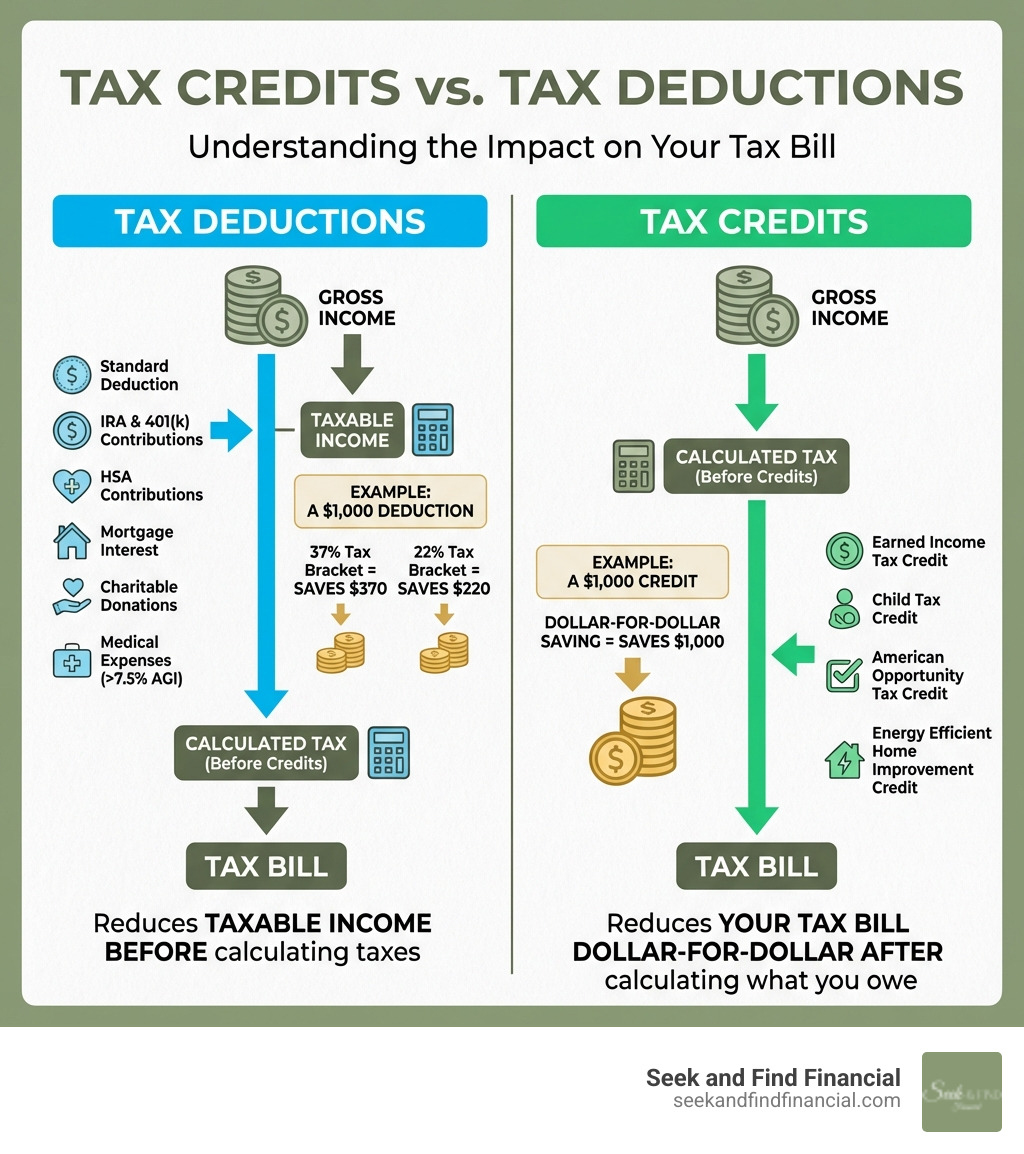
Every taxpayer gets a choice: take the standard deduction or itemize. For 2025, the standard deduction is $15,750 for single filers and $31,500 for married couples filing jointly. If your specific expenses—like mortgage interest, state taxes, and charity—add up to more than that, you should itemize.
Medical expenses can be deducted if they are more than 7.5% of your adjusted gross income (AGI). This includes things like dental work, glasses, and even travel costs for care. Mortgage interest is also a major deduction, though it is limited to interest on the first $750,000 of your home loan.
Charity is a great way to give back while lowering your bill. You can generally deduct cash donations up to 60% of your AGI. A smarter move for high earners is donating "appreciated assets," like stocks that have gone up in value. You get a deduction for the full market value and you never have to pay capital gains tax on the growth. This deduction is usually capped at 30% of your AGI.
To stay safe with the IRS, always follow written acknowledgment rules. You need a receipt for any gift over $250. For very large gifts, you might consider donor-advised funds. This lets you put money into a fund, take the tax deduction today, and then choose which charities get the money over time.
Credits are even better than deductions because they come right off your tax bill. The American Opportunity Tax Credit (AOTC) offers up to $2,500 per year for the first four years of college. The Lifetime Learning Credit (LLC) provides 20% of up to $10,000 in expenses, or a max of $2,000 per year.
Energy credits are also popular right now. The Energy Efficient Home Improvement Credit allows you to claim 30% of the cost for things like new doors, windows, or heat pumps, with an annual limit of $1,200 for most upgrades. If you install solar panels or wind turbines, the Residential Clean Energy Credit covers 30% of the cost with no dollar limit.
The most direct way is to contribute to pretax accounts like a 401(k), traditional IRA, or HSA. These lower your income dollar-for-dollar. For business owners, optimizing your structure and maximizing business deductions are also top priorities.
You should itemize if your total deductible expenses (charity, mortgage interest, state and local taxes up to $10k, and medical costs) are higher than the standard deduction ($15,750 single / $31,500 joint for 2025).
A deduction lowers the income you are taxed on. If you are in the 24% bracket, a $1,000 deduction saves you $240. A credit lowers your actual tax bill. A $1,000 credit saves you exactly $1,000.
At Seek & Find Financial, we believe that tax reduction strategies should be part of a larger, personalized strategy. We don't believe in generic advice because your life in Merrillville, Portage, or Chicago isn't generic. We use technology-driven planning to look at your whole financial picture, ensuring your wealth grows while your tax liability stays as low as legally possible.
If you are looking for a clear path forward, it might be time to partner with a financial advisor who understands the complexities of high-income planning. You can find more info about wealth management services on our website. Let's build a plan that works for you, your business, and your family's future.
Investing involves risk, including possible loss of principal. No investment strategy can ensure financial success or guarantee against losses. Past performance may not be used to predict future results. Provided content is for overview and informational purposes only, reflect the opinions of the author, and is not intended and should not be relied upon as individualized tax, legal, fiduciary, or investment advice.
This information is being provided only as a general source of information. These views may change as market or other conditions change. This information is not intended and should not be used to provide financial advice and does not address or account for an individual’s circumstances. Past performance does not guarantee future results and no forecast should be considered a guarantee. Please seek the guidance of a financial professional regarding your particular financial concerns.
Investment advisory services offered by duly registered individuals through Seek & find Financial LLC a Registered Investment Adviser. Licensed Insurance Professional