

The Complete Guide to Tax Strategies for Business Owners
Discover a year-round tax strategy for business owners: save on taxes, maximize deductions, optimize structures & boost wealth now!
Tax strategy for business owners is no longer just about filing returns in April. It's about protecting your cash flow, reducing your tax bill, and building long-term wealth through decisions you make throughout the year.
Quick Answer: The Most Effective Tax Strategies for Business Owners
If you're earning $400K or more, the gap between what you pay and what you could pay grows significantly without a structured approach. The top 10% of earners pay over half of all income taxes, but those with clear strategies keep more of what they earn.
The difference between business owners who build wealth and those who just stay busy often comes down to one thing: how they handle taxes. Reactive planning means scrambling at year-end and missing opportunities. Proactive planning means making informed decisions throughout the year that compound over time.
I'm Daniel Delaney, founder of Seek & Find Financial, and throughout my career working with individuals and families at established financial institutions and now as an independent advisor, I've seen how a clear tax strategy for business owners transforms financial outcomes. The business owners who thrive aren't just working harder—they're making smarter decisions about how they structure their income, time their expenses, and plan for the long term.
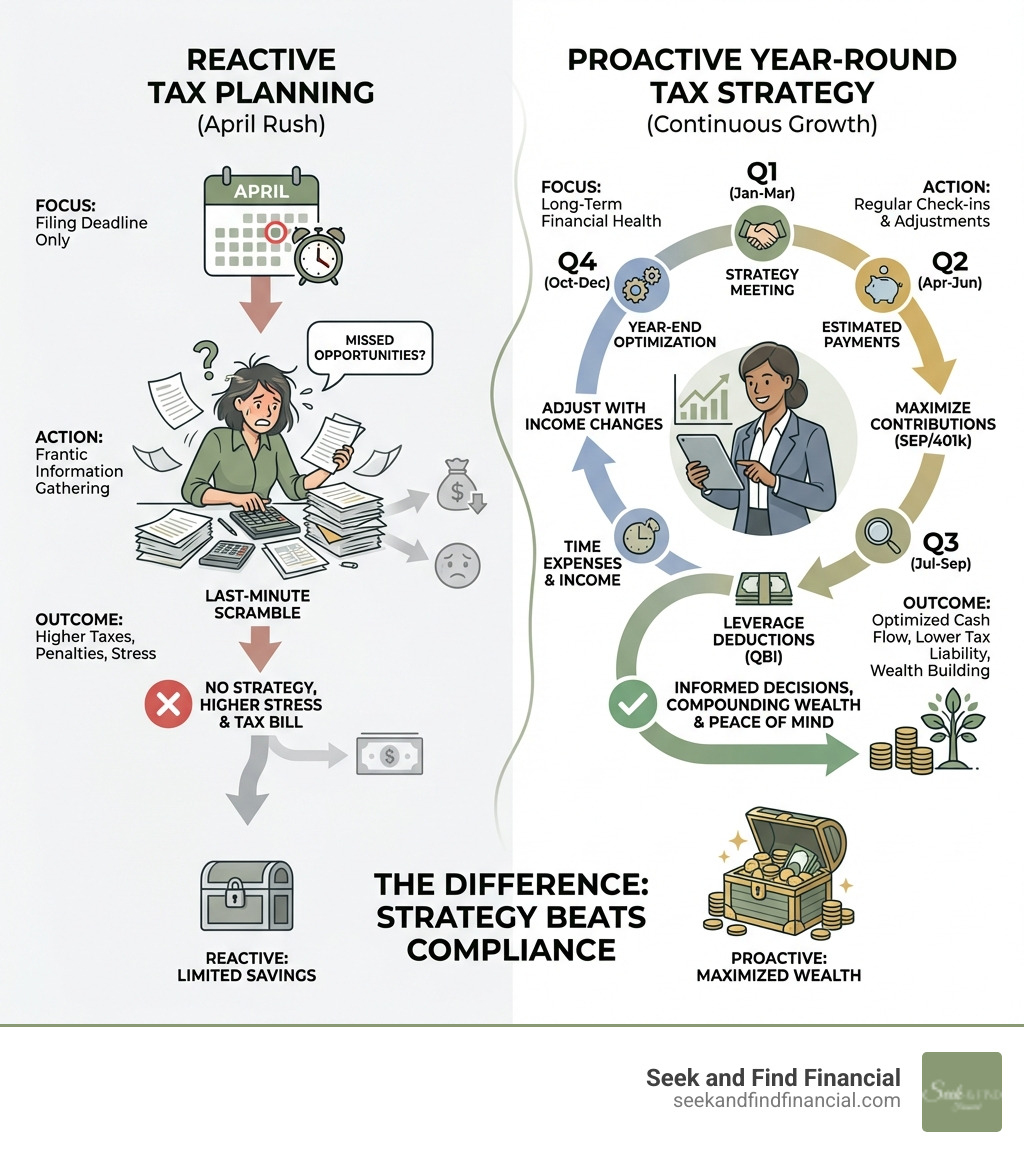
Many people think about taxes only when their accountant calls in the spring. By then, it is often too late to change anything. A year-round tax strategy for business owners allows us to look ahead. It turns tax season from a stressful surprise into a simple check-in.
When we plan throughout the year, we can see how every business choice affects our bottom line. This is especially true for our clients in places like Valparaiso and Crown Point who are managing high-income businesses. Without a plan, you might pay more in taxes than you need to. You might also face penalties from the IRS for not paying enough during the year.
Cash flow is the lifeblood of any business. If you do not plan for taxes, a large tax bill can drain your bank account all at once. We suggest a simple rule: set aside 25% of your gross income for taxes. This ensures you have the money ready when it is time to pay.
The IRS uses a "pay-as-you-go" system. This means you must pay taxes as you earn income. If you are self-employed and expect to owe $1,000 or more, you usually need to make estimated tax payments every quarter. By managing this year-round, you keep your business liquidity stable. You avoid the "tax day heart attack" that happens when you realize you owe the government money you already spent. You can learn more about these requirements on the IRS page for Federal tax responsibilities for businesses.
Tax strategy is not just about saving money today. It is about building wealth for tomorrow. Every dollar you save on taxes is a dollar you can reinvest. That dollar can grow through compound interest over ten or twenty years.
We focus on tax deferral. This means we find ways to push tax payments into the future. This allows your money to stay in your accounts longer. When your money stays in your business or your retirement accounts, it works for you. Over time, this makes a massive difference in your total net worth.
The way you set up your business is one of the biggest factors in your tax bill. A sole proprietorship might be easy to start, but it can be very expensive as you earn more money. For high earners in Northwest Indiana and Chicago, choosing the right entity is a foundational part of a tax strategy for business owners.
| Entity Type | Tax Treatment | Best For |
|---|---|---|
| Sole Proprietorship | All income taxed at personal rates plus 15.3% SE tax | New businesses with low profit |
| LLC (Single Member) | Disregarded entity; same as Sole Prop unless elected otherwise | Simple liability protection |
| S-Corporation | Pass-through; owners pay themselves a salary plus distributions | Businesses with $100K+ in profit |
| C-Corporation | Taxed at corporate level and again on dividends | Large companies planning to go public |
Choosing between these options depends on your goals and your income level. You can find deep details in the IRS Tax guide for individuals using Schedule C.
For many of our clients, the S-Corp election is a game changer. In a regular LLC or sole proprietorship, you pay self-employment tax on all your profits. This tax is 15.3% on the first $176,100 of income for 2025.
With an S-Corp, you split your income into two parts:
You only pay payroll taxes on the salary portion. The distributions are not subject to the 15.3% self-employment tax. If your business makes $200,000 and you pay yourself a $100,000 salary, you could save thousands of dollars in taxes every year.
The Qualified Business Income (QBI) deduction is a powerful tool. It allows many business owners to deduct up to 20% of their qualified business income from their taxes. This is a "below-the-line" deduction, which means it reduces your taxable income directly.
There are limits based on your total income and the type of business you own. For high earners, the deduction might be limited by the wages you pay or the property the business owns. Because this deduction is set to expire after 2025, it is vital to use it while it lasts.
Deductions reduce the amount of income you are taxed on. Credits are even better because they reduce your tax bill dollar-for-dollar. A good tax strategy for business owners uses both.
Not all spending is treated the same by the IRS.
Section 179 allows you to deduct the full cost of certain equipment in the first year instead of spreading it out. For 2025, the limit for Section 179 is $2.5 million. This is a great way to lower your tax bill if you need to buy new tools or technology for your business.
The best tax strategy in the world will fail if you cannot prove your expenses. The IRS requires you to keep records that support your deductions. We recommend keeping digital copies of all receipts and mileage logs.
How long should you keep them? The general rule is to keep records for 6 years. While the IRS usually only goes back 3 years, they can go back further if they find a large error. Keeping good records is your best defense in an audit. Using technology like Altruist helps us keep your financial life organized so you are always ready.
Retirement planning is one of the most effective ways to lower your taxes. When you put money into a retirement account, you are often getting a deduction today and tax-deferred growth for the future.
As a business owner, you have more options than a standard employee.
For a household earning $400K+, these accounts can shield a large portion of your income from taxes.
If your business is a startup or you have equity in a private company, you have unique choices. One of the most important is the 83(b) election. This allows you to pay taxes on your shares when they are granted rather than when they vest. If the shares are worth very little now but might be worth a lot later, this can save you a fortune in future taxes.
We also look at Qualified Small Business Stock (QSBS). Under Section 1202, you might be able to exclude up to 100% of the gain from the sale of your business if you meet certain rules. This is a massive benefit that requires careful planning from the start.
As the year comes to a close, there are specific steps you can take to lower your bill. We call this year-end tax planning. It is about timing your income and your spending.
If you know you will have a high tax bill, you can "pull forward" some of next year's expenses.
By spending this money in December, you reduce your taxable income for the current year.
If you expect to be in a lower tax bracket next year, you might want to delay receiving income. You can wait until January to send out invoices for work done in December. This pushes the tax on that income into the next tax year. This gives you another full year to use that money before the IRS asks for their share.
We recommend setting aside 25% of your gross income. This covers both federal income tax and self-employment tax for most business owners. If you are a very high earner, you might need to save closer to 30% or 35%.
If you are an S-Corp, you need a mix of both. You must pay yourself a "reasonable salary" for the work you do. Any profit left over can be taken as a distribution (dividend), which saves you on self-employment taxes.
You should keep your records for at least 6 years. This includes receipts, bank statements, and past tax returns. This protects you in case of a CRA or IRS audit.
A great tax strategy for business owners is not about finding "loopholes." It is about using the rules of the tax code to your advantage. It is about being proactive and organized. When you align your tax strategy with your life goals, you stop working for your money and start making your money work for you.
At Seek & Find Financial, we help business owners in Valparaiso, Chicago, and beyond create personalized, technology-driven plans. We don't just look at your taxes; we look at your whole financial life to ensure you are on the path to true financial freedom. You can find More info about our wealth management services to see how we can help you grow.
Investing involves risk, including possible loss of principal. No investment strategy can ensure financial success or guarantee against losses. Past performance may not be used to predict future results. Provided content is for overview and informational purposes only, reflect the opinions of the author, and is not intended and should not be relied upon as individualized tax, legal, fiduciary, or investment advice.
This information is being provided only as a general source of information. These views may change as market or other conditions change. This information is not intended and should not be used to provide financial advice and does not address or account for an individual’s circumstances. Past performance does not guarantee future results and no forecast should be considered a guarantee. Please seek the guidance of a financial professional regarding your particular financial concerns.
Investment advisory services offered by duly registered individuals through Seek & find Financial LLC a Registered Investment Adviser. Licensed Insurance Professional