

Working Capital Management for Small Business: Strategies That Actually Work
Master working capital management for small business with proven strategies that boost cash flow, cut costs, and drive sustainable growth.
Working capital management for small business owners is the difference between a company that grows with confidence and one that quietly stalls — even when sales look strong.
Here is a quick summary of what effective working capital management involves:
Consider this: an HVAC contractor generating $3.2 million in annual revenue once found himself unable to make payroll — not because business was slow, but because $480,000 in unpaid invoices were sitting in accounts receivable. That is not a revenue problem. That is a working capital problem.
The gap between earning money and having money available is where many otherwise healthy businesses run into serious trouble. Understanding how to close that gap is what this guide is all about.
I'm Daniel Delaney, Founder of Seek & Find Financial, and my background working within established financial institutions before launching an independent advisory practice has given me a front-row view of how working capital management for small business affects long-term financial health and wealth-building potential. In this guide, I'll walk you through the strategies, metrics, and financing decisions that actually move the needle.
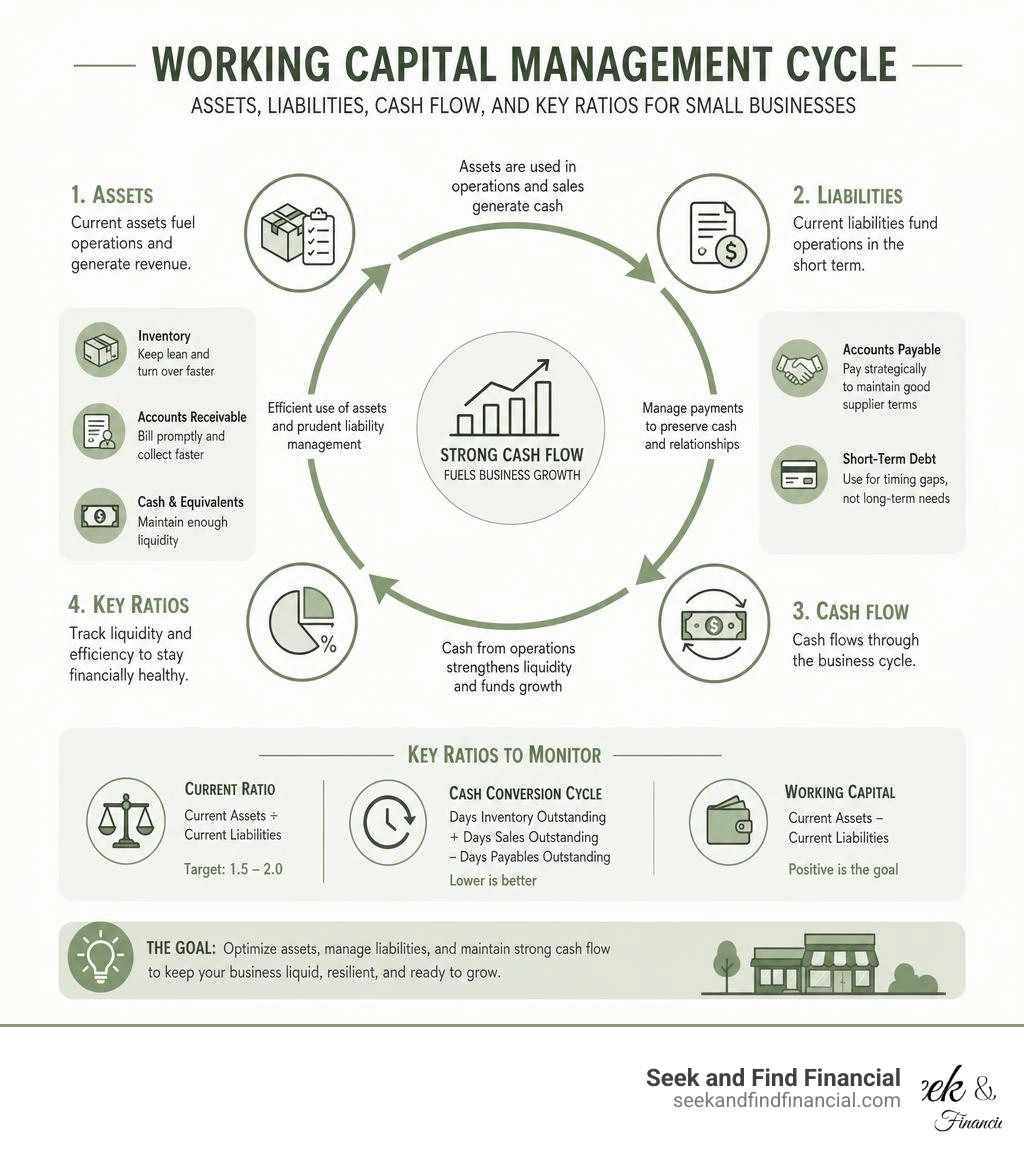
Handy working capital management for small business terms:

Many business owners focus on the bottom line of their income statement. They look at profit and think everything is fine. But profit is an accounting concept. Cash is what you use to pay your bills.
Working capital is the cash and short-term assets you have available to run your daily operations. It is the lifeblood of your business. Without it, you cannot pay your employees, buy inventory, or pay your rent.
Proper working capital management ensures your business stays solvent. Solvency means you can meet your short-term financial obligations as they come due. If you run out of cash, your business can fail even if you are highly profitable.
Our team works with business owners across Northwest Indiana and Chicago. We see this happen when businesses grow too fast. Growth requires cash. You must buy materials and pay labor before your customers pay you. If you do not manage this gap, your growth will stall.
Effective working capital management gives you a safety buffer. It helps you navigate economic downturns or slow seasons. It also improves your creditworthiness. Banks and vendors are more likely to offer good terms when they see you manage your cash well.
You can read more about why this matters on our page about the importance of working capital management in small business.
To manage your working capital, you must first measure it. You can find all the numbers you need on your balance sheet.
There are two main numbers to calculate: net working capital and the working capital ratio.
First, let us look at the working capital formula. To find your net working capital, use this simple calculation:
Net Working Capital = Current Assets - Current Liabilities
Current assets are things you own that you expect to convert to cash within one year. This includes cash in the bank, accounts receivable (money customers owe you), and inventory.
Current liabilities are debts and obligations you must pay within one year. This includes accounts payable (money you owe suppliers), short-term loans, and accrued expenses like payroll and taxes.
For example, let us say a retail shop in Valparaiso has $300,000 in current assets. They have $200,000 in current liabilities. Their net working capital is $100,000.
Second, you should calculate your working capital ratio, which is also called the current ratio. Use this formula:
Working Capital Ratio = Current Assets / Current Liabilities
Using the same retail shop, the ratio is 1.5. This means they have $1.50 in assets for every $1.00 of liabilities.
A working capital ratio of 2:1 is generally considered very healthy. However, some industries can operate well with a ratio as low as 1.2:1. If your ratio is below 1.0, you have negative working capital. This is a major warning sign. It means you may struggle to pay your bills on time.
On the other hand, a ratio above 3.0 might mean you have too much idle cash. That cash could be put to better use by investing it back into your business. For more detailed calculation steps, you can check out the Working capital: Formula and best practices guide.

The working capital cycle is the time it takes to turn your current assets back into cash. It is also known as the cash conversion cycle. This cycle tracks the movement of money through your business.
The cycle has three main parts:
The formula to calculate your cash conversion cycle is:
Cash Conversion Cycle = DIO + DSO - DPO
Let us say you run a small manufacturing shop in Portage. It takes you 40 days to turn raw materials into a finished product and sell it (DIO). Your customers take 30 days to pay their invoices (DSO). Your suppliers give you 25 days to pay for raw materials (DPO).
Your cash conversion cycle is 45 days (40 + 30 - 25). This means your cash is tied up for 45 days before it returns to your bank account. The longer this cycle is, the more working capital you need to keep your business running.
Your business needs two types of working capital: permanent and temporary.
Permanent working capital is the minimum amount of current assets you need to keep your doors open at all times. Even during your slowest month, you still need a baseline of cash, inventory, and receivables to operate.
Temporary working capital is the extra cash you need during peak times. This is very common for seasonal businesses.
For example, a landscaping company in Crown Point experiences huge revenue spikes in the spring and summer. They need extra working capital in late winter to buy mulch, tune up equipment, and hire staff before the busy season starts. Once the summer cash rolls in, they can pay down their temporary debts.
We help business owners separate these two needs so they do not use short-term solutions for long-term problems. You can learn more about balancing these needs on our page about how to manage working capital.
| Feature | Permanent Working Capital | Temporary Working Capital |
|---|---|---|
| Definition | The baseline cash and assets needed year-round | Extra cash needed for seasonal spikes or growth |
| Duration | Long-term and continuous | Short-term and fluctuating |
| Best Funding Source | Retained earnings or long-term loans | Lines of credit or short-term financing |
| Risk of Mismanagement | Can lead to structural insolvency | Can lead to temporary cash crunches |
Efficient working capital management does not just keep you solvent. It directly impacts your profitability and your Return on Invested Capital (ROIC).
ROIC measures how efficient a company is at turning capital into profit. Working capital is part of the denominator in the ROIC formula. If you can reduce the amount of working capital tied up in your business, your ROIC will go up.
Some companies manage this so well that they operate with negative working capital. This means they collect cash from customers before they have to pay their suppliers.
For example, in 2020, Starbucks' loyalty program created $1.456 billion in stored value card liabilities. This acted as customer prepayments, which lowered their working capital needs by that exact amount. In the same year, Amazon achieved a negative 53.1-day cash conversion cycle. They got paid by customers before they paid their vendors.
Conversely, look at Tiffany & Co. in 2020. They had working capital equal to 65.6% of their revenues. They also had a massive 503-day cash conversion cycle because luxury jewelry sits on shelves for a long time. This required a huge amount of cash just to keep the business running.
By reducing your working capital by even $10,000, you free up $10,000 in cash. If you maintain that efficiency, that cash remains available for you to distribute or reinvest. Better working capital management can help businesses increase their ROIC significantly, with some cases showing jumps from 12% to 46%.
For a deeper dive into these metrics, read What is Working Capital Management? A Founder's Guide for 2026.
To optimize your cash cycle, you must focus on your daily operations. You do not always need a loan to fix a cash flow problem. Often, you just need better processes.
We recommend focusing on three main areas: accounts receivable, accounts payable, and inventory. By tweaking these areas, you can unlock hidden cash in your business.
You can read about our approach to this on our Business Capital Management page.
The fastest way to improve your working capital is to get paid quicker. Many small businesses wait too long to invoice. If you finish a job on Tuesday but do not send the invoice until Friday, you are giving away free credit.
Here are a few ways to speed up collections:
At the same time, you must manage your payables. Do not pay your bills earlier than necessary unless you get a discount for doing so. If a vendor gives you Net 30 terms, pay on day 30. This keeps cash in your bank account longer. You can also negotiate with key suppliers to extend your terms from 30 days to 45 or 60 days.
Holding inventory is expensive. It ties up your cash and costs money to store.
To optimize your inventory, you must track your sales velocity. Do not reorder inventory based on habit. Use real sales data from the last 30 days to guide your decisions.
Identify slow-moving stock and run promotions to clear it out. It is often better to sell old inventory at a discount than to let it sit on your shelves. You can also look into drop-shipping models or just-in-time ordering to reduce the amount of stock you must keep on hand.
For more strategic ideas, read The Small Business Owner's Guide to Working Capital.
Sometimes operational tweaks are not enough. If your business is growing rapidly, you may need external financing to bridge the gap.
A working capital line of credit is a great tool for temporary needs. It works like a credit card. You only draw on it when you need it, and you only pay interest on what you use. As a rule of thumb, your working capital line of credit should not exceed 10% of your company's annual revenues.
For larger, permanent working capital needs, a term loan or an SBA 7(a) loan is often a better choice. These loans give you a lump sum with a fixed payment schedule, which helps you plan your cash flow.
If you are a business owner in the Chicago area, you can learn more about local options through Working Capital Loans in Chicago.
Choosing the wrong type of debt can hurt your business.
Do not use a short-term line of credit to buy long-term assets like machinery or real estate. This can drain your daily cash reserve. Likewise, do not take on high-cost merchant cash advances to solve structural cash flow problems.
Borrow to accelerate what is already working, not to patch up a broken business model. If you need help structuring your debt, we can help you build a plan. Read more on our page about Financial Management for Entrepreneurs.
You can also explore corporate treasury strategies via Working Capital Management Solutions.
Managing working capital can raise many questions for business owners. Here are some of the most common questions we hear.
A healthy ratio is generally between 1.5 and 2.0. This means you have a solid buffer to cover your short-term debts.
However, the ideal ratio depends on your industry. A retail store with fast inventory turnover might do well with a 1.2 ratio. A construction company with long project timelines might need a ratio closer to 2.5 to feel secure.
Be careful not to let your ratio get too high. A ratio above 3.0 might mean you are keeping too much cash idle. That cash could be earning a return elsewhere or helping you grow.
For more on this, check out Working Capital Management: The Complete Guide for Small Business Owners.
Yes, absolutely. This is one of the most common reasons small businesses fail. It is called overtrading.
Overtrading happens when you take on too much new business too quickly. You must pay for materials, payroll, and overhead to deliver the new orders. If your customers do not pay you for 60 days, you can run out of cash before you collect your revenue.
Here are five common working capital mistakes to avoid:
To learn more about managing these cycles, see Working Capital Management Explained: A Practical Guide for SMEs - Accounting Reports Daily.
The best tool for this is a rolling 13-week cash flow forecast.
This forecast tracks your expected cash inflows and outflows week by week for the next three months. You should update it every week.
To build your forecast, look at your historical sales data, your current accounts receivable aging report, and your upcoming vendor bills. This will help you spot cash shortages weeks before they happen, giving you time to adjust.
You can find more planning tips in our Business Owner Financial Planning Guide.
You can also read kredline.com for more ideas on daily cash flow management.
Managing your working capital is not a one-time task. It is a continuous discipline. By monitoring your ratios, shortening your cash cycle, and making smart financing decisions, you can build a more stable and profitable business.
At Seek & Find Financial, we help business owners in Valparaiso, Crown Point, Chicago, and surrounding areas align their business finances with their personal wealth goals. We use technology-driven planning to build custom strategies that fit your real life.
Ready to optimize your business capital? Learn more about our approach on our Business Capital Management page.
Investing involves risk, including possible loss of principal. No investment strategy can ensure financial success or guarantee against losses. Past performance may not be used to predict future results. Provided content is for overview and informational purposes only, reflect the opinions of the author, and is not intended and should not be relied upon as individualized tax, legal, fiduciary, or investment advice.
This information is being provided only as a general source of information. These views may change as market or other conditions change. This information is not intended and should not be used to provide financial advice and does not address or account for an individual’s circumstances. Past performance does not guarantee future results and no forecast should be considered a guarantee. Please seek the guidance of a financial professional regarding your particular financial concerns.
Investment advisory services offered by duly registered individuals through Seek & find Financial LLC a Registered Investment Adviser. Licensed Insurance Professional